Is the FBI watching you?
by Richie Koch | March 12 2025 | 1-minute read
The United States claims to be the land of the free, but freedom is impossible without individual privacy. You must be certain the government will not arbitrarily monitor you in your home or on your devices. Yet the US legal system does little to protect your privacy rights, an issue that has existed across multiple administrations. Because of this, we're providing a comprehensive update on how government agencies, law enforcement, and corporations infringe on your data privacy and how to protect yourself online.
Who sees your data, and how do they get away with it?
Section 702 of the Foreign Intelligence Surveillance Act allows agencies to monitor the communications of people outside the US without a warrant. But if US citizens or residents happen to communicate with those people, their data will also be collected. It's then added to a vast database of emails, texts, and calls that the FBI can access.
Law enforcement agencies can also use so-called geofencing warrants, which allow them to collect data from all the devices determined to have been within a specific area at a certain time. This indiscriminate method often sweeps up innocent bystanders, invading privacy on a massive scale. Companies like Google and Apple hand over the location data of tens of thousands of people each year thanks to these warrants.
To sidestep legal requirements, agencies can also purchase data from brokers. These brokers collect detailed personal information, including location, browsing habits, and health records, through apps and online services. Agencies that buy this data avoid the need for warrants, making third-party data collection indistinguishable from direct surveillance.
Finally, National Security Letters (NSLs) allow the FBI to compel companies to hand over sensitive user data without any judicial approval. NSLs often come with gag orders, preventing companies from notifying users of the data request. Big Tech companies like Google, Meta, and Apple receive hundreds or thousands of these secretive requests annually.
How Proton protects your data
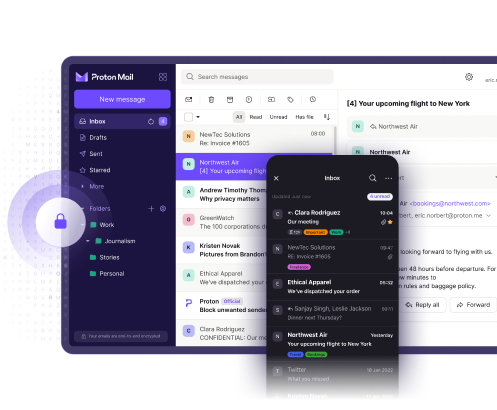
Private email services use end-to-end encryption and other advanced security measures to ensure that only you and your recipients can see your messages. Send a secure email to a friend, and no one else can read it. Proton Mail uses end-to-end encryption and other advanced security measures to ensure that only you and your recipients can see your messages.
With Proton Mail, your privacy is guaranteed:
- Your emails, files, passwords, and schedules are encrypted, so no one can see them.
- Your data is safeguarded under Swiss privacy laws, meaning foreign governments can't access it.
- Unlike Big Tech, Proton is owned by the Proton Foundation, ensuring your data is never compromised for profit.
Protect your privacy with Proton Mail
Choose a plan that works for you
Recommended
Proton Unlimited30-day money-back guarantee
500 GB storage
1 user
15 extra email addresses for you
Support for 3 custom email domains
Unlimited folders and labels
Unlimited hide-my-email aliases
Dedicated customer support
Ultra fast and private VPN
Encrypted password manager
Encrypted cloud storage for photos and documents
Advanced account protection
- Mail Plus
30-day money-back guarantee
15 GB storage
1 user
10 extra email addresses for you
Support for 1 custom email domain
Unlimited folders and labels
10 hide-my-email aliases
Priority customer support
- Proton Duo
30-day money-back guarantee
2 TB storage
Up to 2 users
30 extra email addresses for you
Support for 3 custom email domains
Unlimited folders and labels
Unlimited hide-my-email aliases
Dedicated customer support
Ultra fast and private VPN
Encrypted password manager
Encrypted cloud storage for photos and documents
Advanced account protection
- Proton Free
No credit card required
1 GB storage
1 user
1 email address





As recommended by



I'm a big fan of @ProtonMail! They kept the light on for small tech, independent mail service providers while nobody else seemed to give a damn.

I moved to @ProtonMail 2 years ago and never looked back. The feeling of freedom you get when you know you are not being tracked is uplifting.

You get what you pay for. In the case of big tech, if you pay nothing, you get used. I quit using Gmail and switched to @ProtonMail

My Choice for a Gmail alternative? @ProtonMail - Been using a paid account for over 2 years and it's great. Good customer service also!

The wealth of added features combined with effective end-to-end email encryption makes Proton Mail an Editors' Choice winner for email encryption service.

CNET
It’s hard not to be impressed with the lengths Proton’s gone to shore up security and privacy.

Choose an email trusted by millions of users worldwide
Proton has several plans you can choose from. Paid plans support Proton’s mission to build a better internet where privacy is the default.