Earlier this month, I got an email from MoneySmart(fereastră nouă), a personal finance platform I signed up for years ago to grab a credit card offer. It said hackers had broken into the company’s systems and stolen my name and email address.
If you live in Singapore, you’ve probably had a notice like this in the past couple of months — maybe several. The country is in the middle of an unprecedented wave of data breaches(fereastră nouă). Singapore bills itself as a Smart Nation(fereastră nouă), with trust(fereastră nouă) as a core tenet, one that requires “organisations to do their part.” But over the past three months, I’ve watched company after company fall short.
This article looks at where things went wrong. But more importantly, it’s about what your business can do right, wherever you are in the world, so your customers are far less likely to get an email like the one I did.
What leaked, and why it matters
When that MoneySmart email first landed, I honestly rolled my eyes and moved on. I’ve never had much faith in how private companies handle data, so I’ve always limited how much I shared and thought little of it. But more breaches made the news, and the sheer number of them was not normal. It had me wondering if Singapore was under some sort of cyberattack.
It started with telco Simba(fereastră nouă) in late September. Then the dam broke. By mid-November, at least 12 organizations had disclosed breaches.
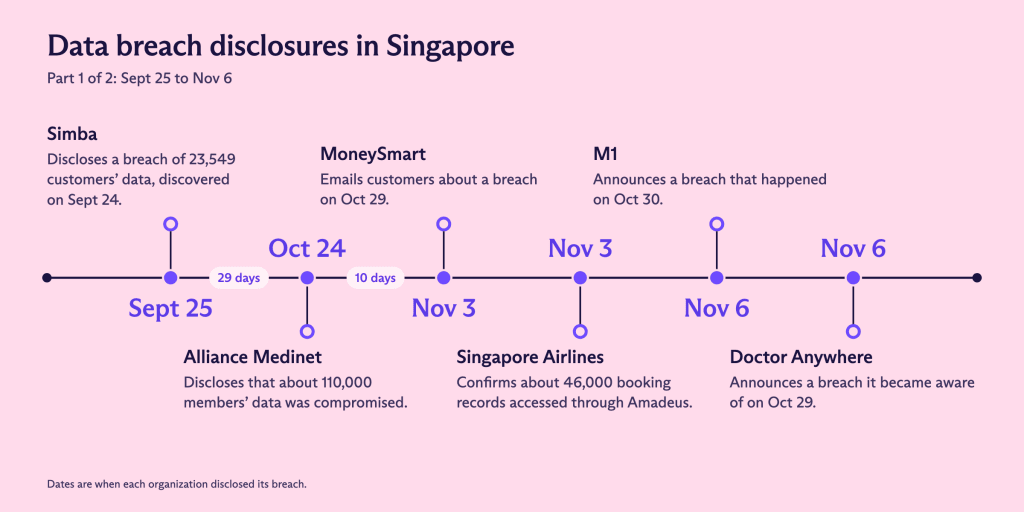
Five of the 12 were healthcare providers: Doctor Anywhere(fereastră nouă), Fullerton Health(fereastră nouă), Minmed(fereastră nouă), Alliance Medinet(fereastră nouă) and the Agency for Integrated Care(fereastră nouă). Doctor Anywhere’s breach exposed patients’ emergency contacts and bank details. Fullerton’s exposed about 140,000 migrant worker records, home addresses included. At the Agency for Integrated Care, up to 4,064 healthcare workers may have had their personal identification numbers accessed.
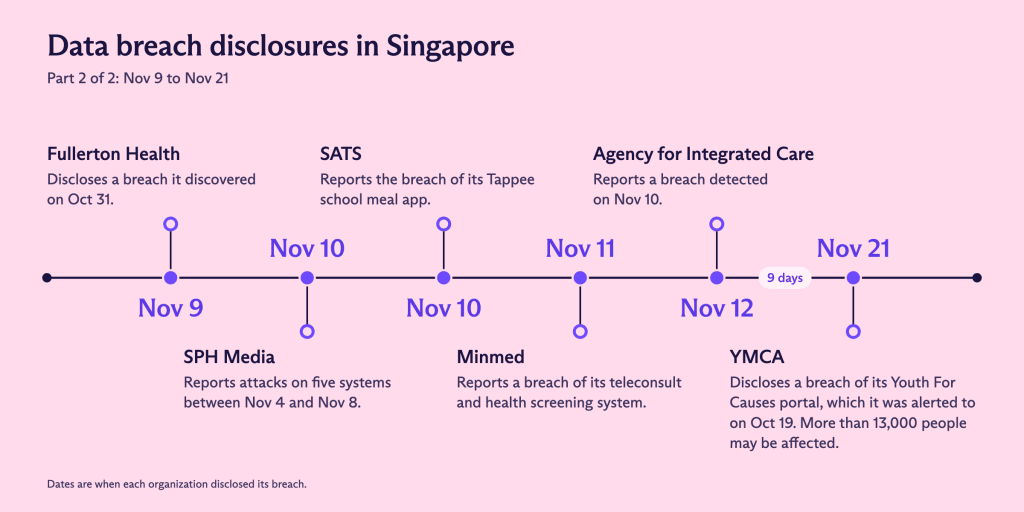
Telco M1(fereastră nouă), MoneySmart(fereastră nouă), Singapore Airlines(fereastră nouă), the YMCA(fereastră nouă), and SPH Media(fereastră nouă) were hit too, and a SATS(fereastră nouă) school meal app leaked students’ names and financial assistance status. None of them have been penalised yet, though that’s likely because investigations are ongoing. In the middle of this wave, retailer Courts(fereastră nouă) was fined a measly 178,000 SGD (less than 140,000 USD) for a 2022 attack affecting nearly a million people.
That MoneySmart notice was the only one I got. Yet, my phone was inundated by calls from spoofed numbers during this period — so where did the callers get my number? Maybe from a breach that hasn’t been disclosed yet. Maybe from an ongoing breach that hasn’t been stopped. Maybe from a data broker who bought it secondhand.
It’s hard, perhaps even impossible, for any single person to trace a given piece of leaked data back to the source of that leak (though you can get alerts of new leaks as they happen). The vulnerability of customers is exactly why companies need to treat data protection seriously.
Singaporeans, like people all over the world, hand over their personal data to companies, often because we have to — to see a doctor, to sign up for a phone line. We trust it will be kept safe. Instead, we’re the ones facing the consequences for companies that, as I see it, never took that trust seriously enough.
With AI, hackers are getting faster
Singapore’s Ministry of Health put out a statement(fereastră nouă) on the healthcare breaches. It warned that AI makes software flaws easy to expose, and that attacks will become “more frequent, rapid and formidable.” The South China Morning Post (SCMP) went further, linking the breaches to AI’s rise and calling it a “new era” of cyber threats(fereastră nouă).
For years, companies assumed they had time between a flaw surfacing and an attacker exploiting it to fix the problem. That buffer is shrinking. Mandiant(fereastră nouă) found that, on average, attackers now exploit flaws about a week before a fix even exists. AI has sped things up — IBM found AI-driven attacks jumped 56%(fereastră nouă) in a year, and these AI-driven breaches cost businesses about 1 million USD more on average.
Many small businesses assume they’re too small to be worth targeting. That kind of thinking is exactly what attackers count on. In Singapore, the Cyber Security Agency’s latest report(fereastră nouă) found that small-medium enterprises (SMEs) were most affected by ransomware in 2025. Proton’s own Data Breach Observatory tells a similar story worldwide: It tracks breaches as leaked data surfaces on the dark web, and most incidents involve smaller businesses.

What these companies did wrong
Paging through the many articles about “the great Singapore breach wave” (coined by me), some common problems keep turning up.
Unpatched and unwatched systems
In the case of Courts, a large retail corporation, the Personal Data Protection Commission (PDPC)(fereastră nouă) found that attackers got in through two disaster recovery servers that were reachable from the internet. Courts had left them out of its regular security scans because they weren’t used for day-to-day operations, and they hadn’t been patched since July 2022, leaving them exposed to flaws that already had fixes. The attacker eventually got hold of a system administrator’s login, reached other systems, and installed ransomware on 26 servers. The PDPC also found other servers running Windows Server 2008, which Microsoft stopped supporting in January 2020.
Fullerton Health and Minmed have both said their breaches involved standalone systems, separate from their main networks. How the attackers got in hasn’t been made public yet.
Cracks in the supply chain
Singapore Airlines was quick to point out that its own IT systems weren’t breached, but that data was taken from Amadeus, which runs part of its booking system. SATS said much the same about its Tappee app, which was developed and maintained by a company called Serial Multivision.
It’s easy to understand why companies are quick to blame software vendors — it is technically true and gives angry customers someone else to focus on. The thing is, customers don’t choose these vendors. We give our details to Singapore Airlines, and Singapore Airlines decides who else they trust with our details. That makes the vendor’s security their responsibility too; they shouldn’t get to step back when that choice goes wrong.
Singapore Airlines has now been caught up in three breaches since 2021(fereastră nouă).
Sitting on too much data
Of the roughly 140,000 records exposed in Fullerton’s breach, about 43,000 belonged to migrant workers whose work passes were no longer valid. That’s tens of thousands of people who had already moved on, whose names, identification numbers, and home addresses were exposed anyway. While there may be legitimate reasons to hold on to records like these, keeping them comes with responsibility, and that responsibility doesn’t expire just because the work pass did.
SATS’s Tappee app, a school meal ordering app, raises a similar question. Some records included students’ allergy profiles, which makes sense for meal orders. But they also included height, weight, and caloric intake, which are harder to justify — all of which were exposed along with other sensitive data.
Keeping customers in the dark
Courts is the starkest case when it comes to communicating with breach victims. It notified affected employees(fereastră nouă), whose bank details had been accessed, but it never told its customers. It decided their exposed data, which included names, identification numbers, addresses, and phone numbers, was unlikely to cause significant harm — despite cybercriminals using personal data to carry out scams.
Compare that with YMCA. After its investigation, it still couldn’t confirm or rule out whether any personal data had been taken, but it contacted more than 13,000 people anyway to explain what was involved and how to protect themselves. Telling people what happened isn’t hard, even when you don’t have all the answers.
On one of the many Reddit(fereastră nouă) threads about Singapore’s data breaches, someone said a scam caller had read their NRIC number back to them to sound legit. Another said they’d started getting emails about loan applications after the Alliance Medinet breach, and all anyone told them was to “be vigilant”. That’s not much help when you don’t even know what’s out there.

The cost of a breach
Nineteen cents — that’s what Courts paid for each of the 946,972 customers and employees whose data was exposed. The retailer was fined 178,000 SGD after arguing down the initial sum of 280,000 SGD. When a company argues an already small fine down, it’s hard not to see data protection as just another cost to minimize. Worth noting is that this is the third breach Courts has faced since 2019. If accountability is as cheap as 19 cents per person, why should any company pay to properly protect personal data?
Well, they should, because the fine, no matter its size, is only part of the bill. Significant costs come from the customer fallout that happens afterwards. In the SCMP report(fereastră nouă), a retiree said he’d stopped using his card online and ignores messages he doesn’t recognize after he started getting phone calls from strangers who knew his full name. He’s not alone. In a 2026 survey, 48% of Singaporeans(fereastră nouă) said they would stop using a tech platform after a serious incident like a data leak.
And breaches are getting more expensive. IBM’s Cost of a Data Breach Report 2026(fereastră nouă) puts the global average at a record 4.99 million USD, and closer to home, the average across ASEAN hit a regional record(fereastră nouă) of 4.12 million USD. Small businesses aren’t spared either; in Proton’s SMB Cybersecurity Report 2026, about 57% of breached small businesses reported losses between 10,000 USD and 100,000 USD.
One of the main things pushing these costs up is lost business(fereastră nouă): Customers who walk away because they no longer trust the company. Every customer who leaves has to be replaced, and customer acquisition isn’t cheap. Unless the security changes, those new customers’ data ends up in the same weak systems. It’s easy to see how that becomes a cycle: lose customers, pay to replace them, then risk losing those too. And in a market as small as Singapore’s, there are only so many customers to win over.
What your business can do right
None of this is new, but the breaches above point to a handful of basics these companies fell short on. If you run a business that holds people’s data, here’s where you should start:
- Know what you run, and keep it updated. Courts’ backup servers were breached partly because nobody was keeping an eye on them. Keep an up-to-date list of every server, app, and system you run, including backups and side projects, and make sure all of them get scanned and updated. Anything that’s no longer supported should be replaced.
- Collect less, and delete what you don’t need. Before asking customers for a piece of information, ask whether you actually need it. Then set a schedule to delete data on former customers and staff. The fewer stale records you hold, the less there is to steal.
- Hold vendors to your standards. As SIA and SATS found out, a vendor’s weak spot becomes yours. Supply chain attacks aren’t just pirates boarding a cargo ship; they’re also when cybercriminals break in through your vendors. According to this breakdown of IBM’s 2026 report(fereastră nouă), a breach through a vendor adds about US$227,000 above average to the cost of your breach. Check how suppliers protect data before you sign on, give them access only to what they need, and put security requirements in the contract.
- Encrypt your data properly. There is no way to fully protect yourself from software flaws, but you can limit the value of stolen data. When data is stored using end-to-end encrypted business solutions, any stolen data is unreadable and therefore useless to whoever takes it.
- Lock down logins. Courts’ attacker got in using a system administrator’s login. Unique passwords and two-factor authentication on every account make that much harder, and a business password manager like Proton Pass makes both easier to enforce across a team.
- Have a plan, and be upfront. Put a data breach response plan in place before you need one. If something does happen, tell customers quickly and clearly what leaked and what you’re doing about it.
A smart nation needs smart businesses
Singapore’s government has spent more than a decade building the digital infrastructure behind its Smart Nation push, and much of it genuinely makes life easier — for example, Singpass(fereastră nouă) makes dealing with government agencies and businesses a lot simpler than it used to be.
Singaporeans have played their part too — using tools like ScamShield(fereastră nouă) to report and block scam calls and filter scam messages, and, hopefully, also doing what we can to protect our personal data. I’m pretty careful with my own data, so this wave frustrated me, because it made one thing abundantly clear: I can do everything right, and it won’t matter if the companies holding my data don’t do their part.
The companies collecting it have to hold up their end. Digital services like these run on trust, and every breach chips away at it. Few of us can opt out of services this entrenched, but we can stop trusting the companies behind them and hand over as little as we can. A Smart Nation built on reluctant users isn’t much of one.
And these lessons aren’t just for Singaporean companies. If a country this invested in going digital can see breach after breach, no one is safe.