Jede Feiertagssaison füllen sich die Posteingänge in den Vereinigten Staaten schnell. Nachrichten kommen in Schüben an, Betreffzeilen werden immer dringlicher, und es wird schwieriger, den ständigen Fluss an Werbeaktionen zu verwalten. Für die meisten Menschen ist das einfach der Lauf der Dinge. Völlig normal.
Unter der Haube dieser Werbekampagnen verbirgt sich jedoch etwas weitaus Gruseligeres.
Die meisten Marketing-E-Mails enthalten versteckte Tracker, die melden, wann du eine Nachricht öffnest, welches Gerät du benutzt und ob du klickst. Marken nutzen diese Informationen dann, um zu entscheiden, wann sie dir das nächste Mal eine E-Mail senden und wie oft. Während der Weihnachtseinkaufssaison intensiviert sich dieses System, was zu einem vorhersehbaren Anstieg des Volumens und im Wesentlichen zu einer Überwachung deiner Online-Aktivitäten und Gewohnheiten führt.
Um dies klarer zu messen, erstellte Proton Spam Watch: The U.S. Inbox Overload + Hidden Tracker Report, eine kontrollierte Analyse darüber, wie sich 50 der größten US-Einzelhandelsmarken in den Wochen vor und während der geschäftigsten Einkaufszeit des Jahres verhielten.
Lies den vollständigen Bericht hier:
Wie Spam Watch funktioniert
Wir haben einen dedizierten Proton Mail-Testposteingang eingerichtet – trackers.us@proton.me – und ihn bei 50 großen US-Einzelhandelsmarken abonniert. Für jede empfangene E-Mail haben wir Folgendes aufgezeichnet:
- Absender
- Betreffzeile
- Datum und Uhrzeit
- Anzahl der erkannten Tracker
- Tägliche und wöchentliche Sendemuster
- Wiederholte oder hochfrequente Sendungen
Wir konnten diese Daten messen, weil Proton Mail darauf ausgelegt ist, diese versteckten Tracker auf verschiedene Weisen zu identifizieren, darunter:
- Blockieren von Inhalten aus externen Quellen
- Unsichtbarer Pixelschutz
- Link-Bereinigung (die Tracking-Parameter entfernt, während die Funktionalität erhalten bleibt)
Diese Tools gaben uns eine transparente, konsistente Möglichkeit, sowohl das E-Mail-Volumen als auch das E-Mail-Tracking während der Weihnachtszeit zu messen.
Wann wir es gemessen haben
Wir haben Nachrichten über drei spezifische Zeiträume hinweg analysiert:
1. Zeit vor Black Friday (Basislinie): 4. Nov. → 27. Nov.
Typisches saisonales Senden, bevor Feiertagsaktionen intensiver werden.
2. Weihnachtseinkaufszeitraum (Black Friday bis Cyber Monday): 28. Nov. → 1. Dez.
Historisch gesehen der Zeitraum mit dem höchsten Volumen des Jahres für Einzelhandels-E-Mails.
3. Vollständiger Analysezeitraum: 4. Nov. → 1. Dez.
Alle Ergebnisse und Ranglisten in diesem Bericht basieren auf diesem kompletten Fenster.
Diese Fenster helfen uns, sowohl die Basislinie als auch die saisonale Spitze beim Senden und Tracken zu messen.
Was wir gefunden haben
Die diesjährigen Daten bestätigen einen deutlichen Wendepunkt im digitalen Marketing:
- 80 % der großen US-Einzelhändler betteten Tracker in 100 % ihrer Marketing-E-Mails ein.
- Das Posteingangsvolumen stieg während der Weihnachtsspitze um 93 % an.
- Wohn- und Dekorationsmarken waren insgesamt am aggressivsten.
- Dessous- und Wäschemarken packten die meisten Tracker in jede Nachricht.
- Kaufhäuser führten bei der reinen Häufigkeit.
Überlastung des Posteingangs ist kein persönliches Organisationsproblem.
Es ist ein konstruiertes Ergebnis.
Welche Marken waren die schlimmsten Übeltäter?
Wenn man die durchschnittlichen täglichen E-Mails mit der durchschnittlichen Tracker-Anzahl multipliziert, kommen diese Marken als die Schlimmsten der Schlimmsten heraus. Dieser einzelne Wert erfasst sowohl, wie oft eine Marke dir E-Mails sendet, als auch wie dicht jede E-Mail mit Trackern gepackt ist.

- CB2 – Punktzahl: 27,39 (13,00 Tracker/E-Mail × 2,11 E-Mails/Tag)
- Anthropologie – Punktzahl: 24,31 (12,90 Tracker/E-Mail × 1,88 E-Mails/Tag)
- Victoria’s Secret – Punktzahl: 21,75 (13,84 Tracker/E-Mail × 1,57 E-Mails/Tag)
- VS Pink – Punktzahl: 16,00 (14,00 Tracker/E-Mail × 1,14 E-Mails/Tag)
- Crate & Barrel – Punktzahl: 15,71 (7,86 Tracker/E-Mail × 2,00 E-Mails/Tag)
- kate spade – Punktzahl: 12,00 (5,51 Tracker/E-Mail × 2,18 E-Mails/Tag)
- Pottery Barn – Punktzahl: 11,25 (5,00 Tracker/E-Mail × 2,25 E-Mails/Tag)
- DICK’S Sporting Goods – Punktzahl: 9,82 (3,31 Tracker/E-Mail × 2,96 E-Mails/Tag)
- Lowe’s – Punktzahl: 9,73 (4,42 Tracker/E-Mail × 2,20 E-Mails/Tag)
- Urban Outfitters – Punktzahl: 9,00 (4,00 Tracker/E-Mail × 2,25 E-Mails/Tag)
- J. Crew – Punktzahl: 8,16 (8,50 Tracker/E-Mail × 0,96 E-Mails/Tag)
- Aerie – Punktzahl: 7,71 (9,00 Tracker/E-Mail × 0,86 E-Mails/Tag)
- Ulta Beauty – Punktzahl: 6,50 (12,00 Tracker/E-Mail × 0,54 E-Mails/Tag)
- NORDSTROM – Punktzahl: 6,00 (2,90 Tracker/E-Mail × 2,07 E-Mails/Tag)
- JCPenney – Punktzahl: 5,89 (3,00 Tracker/E-Mail × 1,96 E-Mails/Tag)
Welche Marken haben die meisten E-Mails gesendet?
Einige Einzelhändler sendeten gelegentlich E-Mails. Andere sendeten ständig E-Mails – mehrmals täglich, jeden Tag. Diese Marken repräsentieren die höchste tägliche Frequenz über das gesamte Studienfenster hinweg – diejenigen, die ständig um Aufmerksamkeit buhlen.
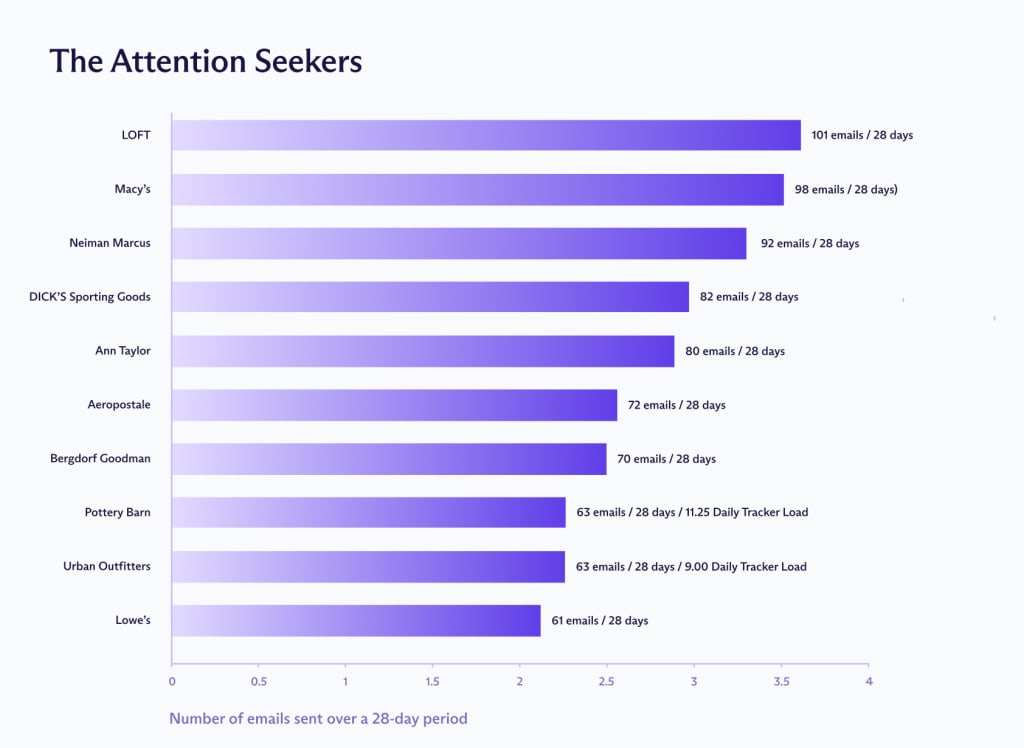
- LOFT – Punktzahl: 3,62 (101 E-Mails / 28 Tage)
- Macy’s – Punktzahl: 3,52 (98 E-Mails / 28 Tage)
- Neiman Marcus – Punktzahl: 3,32 (92 E-Mails / 28 Tage)
- DICK’S Sporting Goods – Punktzahl: 2,96 (82 E-Mails / 28 Tage)
- Ann Taylor – Punktzahl: 2,88 (80 E-Mails / 28 Tage)
- Aeropostale – Punktzahl: 2,59 (72 E-Mails / 28 Tage)
- Bergdorf Goodman – Punktzahl: 2,50 (70 E-Mails / 28 Tage)
- Pottery Barn – Punktzahl: 2,25 (63 E-Mails / 28 Tage / 11,25 tägliche Tracker-Last)
- Urban Outfitters – Punktzahl: 2,25 (63 E-Mails / 28 Tage / 9,00 tägliche Tracker-Last)
- Lowe’s – Punktzahl: 2,20 (61 E-Mails / 28 Tage)
Welche Marken haben die meisten Tracker eingebettet?
Viele Marken haben keine hohen Volumina gesendet. Aber wenn sie E-Mails sendeten, packten sie jede Nachricht mit einer ungewöhnlich großen Anzahl von Trackern voll – manchmal mehr als ein Dutzend in einer einzigen E-Mail. Diese Marken repräsentieren die höchste „Überwachungsintensität“, gemessen an den durchschnittlichen Trackern pro E-Mail.

- VS Pink – 14,00 Tracker pro E-Mail
- Victoria’s Secret – 13,84 Tracker pro E-Mail
- CB2 – 13,00 Tracker pro E-Mail
- Anthropologie – 12,90 Tracker pro E-Mail
- Ulta Beauty – 12,00 Tracker pro E-Mail
- Aerie – 9,00 Tracker pro E-Mail
- J. Crew – 8,50 Tracker pro E-Mail
- Crate & Barrel – 7,86 Tracker pro E-Mail
- REI – 6,83 Tracker pro E-Mail
- kate spade – 5,51 Tracker pro E-Mail
Welche Marken haben Posteingänge am meisten überflutet?
Diese Einzelhändler produzierten die größten Eintages-Spitzen – die Momente, in denen sich Posteingänge wirklich chaotisch anfühlten. Diese Metrik erfasst die Spitzenüberlastung: die maximale Anzahl von E-Mails, die eine Marke an einem einzigen Tag während des Feiertagsansturms gesendet hat.
Die Posteingangs-Fluter
- Macy’s – (Spitze: 7 | Täglicher Durchschnitt: 3,14) | Spitzendatum: 29. Nov. (Samstag des Feiertagswochenendes)
- LOFT – (Spitze: 6 | Täglicher Durchschnitt: 3,36) | Spitzendatum: 28. Nov. (Black Friday) & 30. Nov. (Sonntag)
- Bass Pro Shops – (Spitze: 6 | Täglicher Durchschnitt: 1,75) | Spitzendatum: 28. Nov. (Black Friday)
- Saks OFF 5TH – (Spitze: 6 | Täglicher Durchschnitt: 1,61) } Spitzendatum: 30. Nov. (Sonntag)
- Ann Taylor – (Spitze: 5 | Täglicher Durchschnitt: 2,68) | Spitzendatum: 28. Nov. (Black Friday)
- Pottery Barn – (Spitze: 5 | Täglicher Durchschnitt: 2,25) | Spitzendatum: 1. Dez. (Cyber Monday)
- kate spade – (Spitze: 5 | Täglicher Durchschnitt: 2,18) | Spitzendatum: 18. Nov.
- NORDSTROM – (Spitze: 5 | Täglicher Durchschnitt: 2,07) | Spitzendatum: 29. Nov. (Samstag)
- Anthropologie – (Spitze: 5 | Täglicher Durchschnitt: 1,75) | Spitzendaten: 25. Nov. – 1. Dez. (eine Woche am Stück)
- Gap – (Spitze: 5 | Täglicher Durchschnitt: 1,54) | Spitzendatum: 26. Nov. (Tag vor Thanksgiving)
Was wir sonst noch entdeckt haben
Während die obigen Metriken die wichtigsten Erkenntnisse für Verbraucher erfassen, enthüllte unsere tiefere Analyse mehrere Muster:
Wohnkultur- und Luxus-Wohnmarken waren die „doppelten Bedrohungen“
Sie kombinierten hohes Sendevolumen mit hoher Tracker-Dichte. CB2, Crate & Barrel und Pottery Barn zählten insgesamt zu den invasivsten Absendern.
Dessous- und Wäschemarken führten die Tracking-Charts an
VS Pink, Victoria’s Secret und Aerie hatten durchschnittlich 9–14 Tracker pro Nachricht – die höchsten in der Studie.
Kaufhäuser dominierten das hochfrequente Senden
Macy’s und LOFT sendeten regelmäßig 3–4 Nachrichten pro Tag, jeden Tag.
Einige große Einzelhändler stachen dadurch hervor, dass sie das Richtige taten
H&M, TJ Maxx, Burlington, Bass Pro Shops und New Balance sendeten null E-Mails mit Trackern – ein Beweis dafür, dass Überwachung nicht notwendig ist, um ein modernes E-Mail-Programm für den Einzelhandel zu betreiben.
Kein großer US-Einzelhändler erfüllte den „Proton Goldstandard“
Keiner erfüllte beide Bedingungen von:
- Null Tracker
- Niedriges Volumen (< 0,5 E-Mails/Tag)
Privatsphäre respektierendes E-Mail-Marketing ist möglich – aber fast niemand macht es.
Proton Mail blockiert verstecktes Tracking standardmäßig
Die Ergebnisse von Spam Watch 2025 unterstreichen eine einfache Wahrheit: Überlastung des Posteingangs wird durch weitverbreitetes Tracking und hohes Sendevolumen getrieben, nicht durch persönliche Desorganisation.
Proton Mail reduziert dieses Problem an der Quelle:
- Tracker-Blockierung verhindert das Laden unsichtbarer Pixel
- Kontrolle über Inhalte aus externen Quellen verhindert bildbasiertes Tracking
- Link-Bereinigung entfernt Tracking-Parameter
- Intelligente Filterung hilft, Werbeaktionen einzudämmen
- Privatsphäre als Standard hält das Verhalten im Posteingang privat
Diese Schutzmaßnahmen begrenzen die Daten, auf die sich Vermarkter verlassen, was zu weniger Trackern und weniger unnötigen Follow-up-E-Mails führt.
Ein privaterer, besser verwaltbarer Posteingang ist möglich
Spam Watch hilft dabei, die versteckte Schicht des E-Mail-Marketings sichtbar zu machen. Indem wir messen, wie sich Marken während der Weihnachtseinkaufssaison verhalten, können wir zeigen, warum sich Posteingänge überwältigend anfühlen – und wie Privatsphäre-First-Tools dieses Erlebnis verändern.
Proton Mail zielt darauf ab, den Menschen das zu geben, was die Daten zeigen, dass sie es brauchen: einen besseren Posteingang und weniger Unternehmen, die jeden ihrer Schritte online aus Profitgründen tracken.