Citizens of Denmark, Sweden, Norway, and Finland are becoming increasingly critical of US tech companies and worried about their outsize power in Europe. Much like their neighbors to the south, consumers in the Nordic countries believe Europe has become overly dependent on Big Tech companies answerable to Washington and think it’s time to find alternatives.
A new Proton survey of 4,000 people living in Nordic countries found that around 83% believe Europe is reliant on US apps and services, and 85% find this reliance concerning.
In our earlier study of 3,000 people across the UK, France, and Germany, we discovered that 73% believed their societies were far too dependent on US tech companies. Recently, the French government said it was dropping Windows(new window) and other US services, and Germany(new window) and other countries(new window) are also seeking European digital sovereignty. The de-Americanization trend is clear.
But what about the Nordic countries? Perhaps unsurprisingly, they were just as worried, if not more so.
- Nordic citizens are more likely to want to switch to European tech services than people in other European countries are.
- 64% of those who follow the news say that tensions between the US and Europe have changed how they feel about using US tech apps and services.
- Data sovereignty and pro-European sentiment are the strongest motivators for people in Nordic countries when choosing European tech.
Geopolitical tensions between the United States and the Nordic countries have skyrocketed since January. President Trump threatened to invade Greenland(new window), a Danish territory. Greenland’s Prime Minster Jens Frederik-Nielsen has continually pushed back on US aggression and called on NATO(new window) to defend it against invasion. Subsequently, Trump threatened to end the US military alliance(new window) with Europe.
Amid this turbulence, consumer attitudes toward US tech are changing. Our survey investigates how the current political landscape is shaping the attitudes of citizens in Nordic countries.
Resistance to US tech is strongest in Nordic countries
- 85% of Danish respondents believe Europe is very or extremely dependent on US technology companies, with 87% expressing concern about this dependence
- 78% of Norwegian respondents believe Europe is very or extremely dependent on US technology companies, with 84% expressing concern about this dependence
- 82% of Swedish respondents believe Europe is very or extremely dependent on US technology companies, with 81% expressing concern about this dependence
- 86% of Finnish respondents believe Europe is very or extremely dependent on US technology companies, with 89% expressing concern about this dependence

People in Nordic countries are even more concerned about over-reliance on US tech than their European counterparts. This is unsurprising, given the contentious standoff between Denmark and the United States over Greenland.
It has become obvious to most consumers that anything you do using US tech will never be private. Cloud storage, email, and messaging apps operating out of the US capture activity that can potentially be shared with the NSA, even when users are based in another country. This is thanks to agreements such as Five Eyes, Nine Eyes, and Fourteen Eyes(new window), which allow intelligence gathering across borders.
Section 702 of the Foreign Intelligence Surveillance Act (FISA) has also allowed the US to surveil foreigners overseas without suspecting terrorism or requiring approval from a court since 2008. Europeans’ communications including emails, phone calls, text messages and more can be demanded from American companies from intelligence agencies.
People in Nordic countries and their European neighbors don’t want to be subject to unwarranted surveillance, and they’re getting less comfortable with sending money abroad to companies that constantly flout data regulations.
The Nordic countries also have a healthy software industry of their own, with many newer organizations pursuing alternative strategies to their US counterpart. Rather than focusing on personal data collection or social media, these new software companies are focusing on solutions for specific, less digitized industries such as construction, regulation enforcement, and real estate. As this industry grows and resistance to US tech increases, Nordic countries are clearly more interested in finding or even building alternatives.
Nordic sentiment is strongly influenced by the news
- 67% of Danish respondents of those who follow the news state that growing tensions between the US and Europe motivate them to prefer European services.
- 65% of Norwegian respondents of those who follow the news state that growing tensions between the US and Europe motivate them to prefer European services.
- 65% of Swedish respondents of those who follow the news state that growing tensions between the US and Europe motivate them to prefer European services.
- 60% of Finnish respondents of those who follow the news state that growing tensions between the US and Europe motivate them to prefer European services.


Globally, the US’s behavior on the world stage has drawn sharp criticism in recent months. Trump’s threats of leaving NATO have united(new window) member countries in opposition. Even within the US itself, protests have broken out against the administration, acts of violence by ICE agents, and the invasion of Iran.
US tech is deeply entwined with the US government. When Trump’s second term began, Big Tech leaders took their place at the inauguration to signal their willingness to work with the administration. OpenAI’s close and changing relationship with(new window) the US military(new window) and DHS officials’ unsanctioned use(new window) of Meta’s Ray-Ban smart glasses are just two recent examples of the blurring boundary between Big Tech’s surveillance platforms and government operations.
Clashing values are likely a driving force behind the change in perception toward American tech. When people in Nordic countries see that Meta endangers child safety(new window), or that Google doesn’t keep their photos private, this reinforces the idea that these companies don’t share the Nordic values of building a healthy society and conducting business ethically.
Desire for secure European tech is growing
- If a European app or online service could match the price, features, and usability of an American app or service, 71% of Danes would prefer companies based in Europe
- If a European app or online service could match the price, features, and usability of an American app or service, 75% of Norwegians would prefer companies based in Europe
- If a European app or online service could match the price, features, and usability of an American app or service, 67% of Swedes would prefer companies based in Europe
- If a European app or online service could match the price, features, and usability of an American app or service, 74% of Finns would prefer companies based in Europe

Once again, people in Nordic countries are more likely to prefer European tech if they had access to tech of equal quality. Much like their European neighbors, Nordic respondents are keen to find alternatives to the American tools they’re already using.
Interest in building the EuroStack(new window) has significantly grown in recent year, for obvious reasons. The European Commission has issued more than $7 billion in fines to Google, Apple, and Meta since the start of 2024, which the White House is positioning as over-regulation that will ultimately prevent the EU from benefiting from AI.
When asked which features would encourage them to choose a European app or service, respondents said they want products that protect their privacy with local laws and support their own economies.
In Denmark:
- 49% want to support the European economy
- 48% want their data stored under European laws
- 47% want greater trust when it comes to processing personal data
In Norway:
- 55% want stronger data-privacy protections overall
- 54% want their data stored under European laws
- 53% want greater trust when it comes to processing personal data
In Sweden:
- 49% want their data stored under European laws
- 47% want stronger data-privacy protections overall
- 47% want to support the European economy
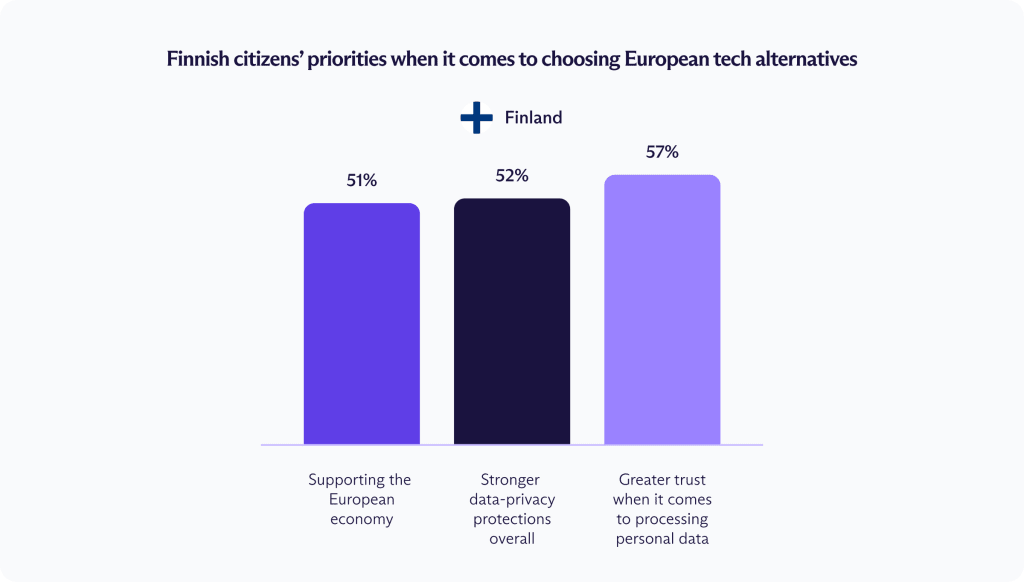
In Finland:
- 57% want greater trust when it comes to processing personal data
- 52% want stronger data-privacy protections overall
- 51% want to support the European economy


Nordic countries are ready to make a change
- 65% of Danish respondents agree that people in Europe should rely more on European technology companies for everyday apps and services
- 66% of Norwegian respondents agree that people in Europe should rely more on European technology companies for everyday apps and services
- 62% of Swedish respondents agree that people in Europe should rely more on European technology companies for everyday apps and services
- 69% of Finnish respondents agree that people in Europe should rely more on European technology companies for everyday apps and services

Around two-thirds of Nordic respondents say they want more buy-in from Europeans for homegrown technology. To make this happen, we need to understand what’s at stake if Europe continues to rely on US tech.
US Big Tech companies have created not just a technological monopoly, but also a global surveillance apparatus. This apparatus is being used to dominate international markets, control political narratives, and invade the privacy of citizens everywhere.
Breaking up with Big Tech itself isn’t that simple, given the enormous monopolies US companies hold. Denmark is refusing to sign licensing deals(new window) with Meta and Google, building its own Danish Press Collective Management Organization (DPCMO) to empower the country’s media ecosystem. However, the country has also hosted a Google data center(new window) since 2020. We’re watching sentiments towards US tech change in real time, and consumer attitudes will likely affect the directions that governments choose to take.
There’s never been a better time to switch to European tech
Now that there’s a groundswell of desire for better European tech, a change is possible. Once Europeans and people in Nordic countries know exactly what’s at risk when they keep relying on Google, Meta, and Microsoft, they know they want to protect themselves against this surveillance. In the past, there haven’t been European tech options that could compete with US tech — but that’s changing.
Surveillance isn’t automatically built into every tech product — that’s a deliberate choice made by US companies that people around the world have now come to expect from every service. But everything from email to video calls to AI chatbots can actually be private (and should be.)
Proton operates out of Switzerland, giving people in every country around the world Swiss regulatory data protection and access to end-to-end encryption that prevents international surveillance. We understand what’s at stake if the US continues to dominate the world with Big Tech; that’s why we’ve built an ecosystem that competes with those services without compromising on data privacy. By choosing European alternatives like Proton, it’s possible to both support the European economy and protect your own personal data.