Money worries at 2 a.m.. A medical symptom too embarrassing to see a doctor about. The best way to ask someone on a date.
People discuss their most private thoughts with AI chatbots. But their revelations to the apps doesn’t mean they trust the Big Tech companies behind them, according to new research from Proton.
Roughly two-thirds of AI chatbot users have discussed at least one sensitive topic. But at the same time, fewer than one in five say they have a high level of trust in AI companies to protect their private information.
“AI is learning far more about us than a search engine ever could. Search knows what you looked for. AI gets the hesitation, the follow-up questions, and the personal context between the lines,” said Eamonn Maguire, director of AI engineering at Proton. “We’re handing over more than questions now. And when technology knows that much about us, privacy can’t be an afterthought.”
To understand more about how people use and perceive AI, we surveyed 4,014 current AI chatbot users across France, Germany, the UK, and the US. We asked what they’ve shared, why they chose to do so, and what would make them more or less willing to share it.
Key findings
- 66% of AI chatbot users have discussed at least one sensitive topic with a chatbot, including personal finances, sexual health, and relationships.
- 42% of users have little or no trust in AI companies to protect sensitive information shared with chatbots.
- Money, mental health, and career problems are the three most commonly discussed sensitive topics.
- AI users would still rather discuss sensitive topics with friends and family, ahead of AI chatbots and therapists.
- Convenience and freedom from judgment are the most commonly cited reasons for choosing AI over a person.
- 48% of users say they would be more willing to share sensitive information if their conversations were guaranteed to not be used to train AI models.
- Eight in 10 users express interest in an AI chatbot specifically designed for privacy.
Most chatbot users have already shared something sensitive
66% of respondents said they discussed at least one sensitive topic with an AI chatbot. The eight topics covered personal finances, relationships, mental health, sex, secrets, romantic attraction, work, and family conflict.
Of the surveyed countries, Americans reported the highest rate of disclosing sensitive information to chatbots at 68.4%, with France being the lowest at 60.3%. This gap suggests openness to confiding in AI isn’t just a personal choice, but could be influenced by broader cultural attitudes toward privacy and technology.
Money, mental health, and work dominate sensitive topics
Personal finances, mental health, and career problems were the three sensitive topics respondents most commonly reported discussing with AI.
The most commonly discussed topic varied by country. Mental health ranked first in Germany, while career problems ranked first in the US, and personal finances ranked first in France and the UK.

These results show which sensitive topics respondents have discussed with AI, but not why they chose to discuss them.
Friends and family are the top choice, even as AI use grows
Friends and family were the preferred choice for discussing every sensitive topic surveyed, ahead of AI chatbots, therapists, and religious advisors. But AI is already competing with traditional sources of support in some areas — particularly money and work.
The gap between AI and human advice is smallest when it comes to money. In France, AI came within just 2 percentage points of friends and family as the preferred choice for discussing personal finances.
And AI’s influence doesn’t stop at conversation. People are using it to make decisions about their money, health, relationships, careers, and purchases.

Convenience and freedom from judgment are biggest draws for using AI
Convenience and freedom from judgment were the most commonly cited reasons for choosing an AI chatbot over a person to discuss a sensitive topic. Privacy was also a common reason, but ranked lower.

Reasons generally varied by country and topic. Of the top three most-discussed sensitive topics, work and career problems was the only one where all four countries agreed on the same top reason: convenience. Personal finances came close, with every country except the UK favoring convenience too. Mental health was split down the middle: France and Germany both chose convenience as the top reason, while the US and UK valued freedom from judgment more highly. Meanwhile, romantic attraction had trust and privacy as the top choice across Germany, the UK, and the US, while sexual health had judgment-free as the top reason across France, the US, and the UK.
Together, this suggests convenience wins out for practical topics, while privacy and freedom from judgment matter more for personal conversations.
Ad profiling raises more concern than AI model training
Respondents expressed more concern about their conversations being used for advertising profiles than being used to train AI models.

The difference was largest in the US, where 65.3% were more worried about ad profiling compared with 57.6% for model training. The results suggest that how conversation data is used matters, with key concerns being less about having conversations saved and remembered than having that data turned into a commercial asset used for monetary profit.
Trust in AI companies stays low across the board
Despite widespread sharing of sensitive topics with AI chatbots, only 11% to 20% of respondents reported a high level of trust in AI companies with their private information. Low trust was most common in France at 47.7%, with 41.6% in the UK, 40.5% in Germany, and 38.8 in the US.
Privacy commitment increases willingness to share
A guarantee that conversations wouldn’t be used to train AI models would make 44% of respondents more likely to share sensitive information. This was highest in the US at 47.7%, followed by the UK at 44.3%, Germany at 43.9%, and France at 40.7%.

Interest was also high in AI chatbots designed around privacy. Over 70% of people said they would be more likely to use one, ranging from 71.1% in Germany to 82% in the UK.
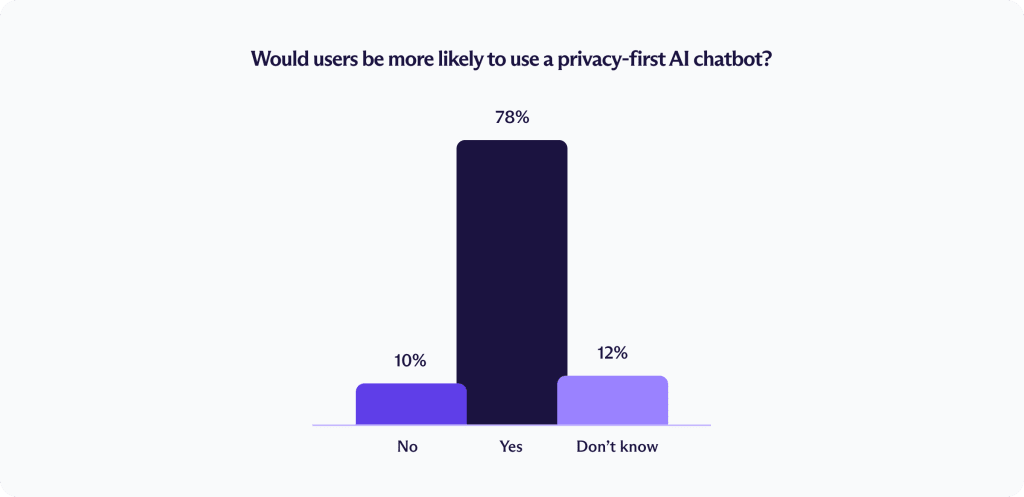
These findings suggest that a commitment to privacy is still highly regarded for AI chatbot users, even if it wasn’t the initial reason that a user would choose to use AI.
Conclusion: AI must earn the trust of its users
Personal conversations with AI chatbots are already common. More than two-thirds of respondents across the four countries surveyed had discussed at least one sensitive topic with an an AI chatbot, from money worries to personal secrets. Yet only one in five reported a high level of trust in AI companies with their private information.
People are confiding in AI much faster than they trust it, but not because AI has replaced human connection — friends and family remain the first choice for every sensitive topic. Rather, AI is the option that people reach for when convenience and freedom from judgment matter more.
While convenience opens the door for someone to use AI, it’s trust that decides how far they’ll go with it. A no-training guarantee was enough to make 44% of users more willing to share, and eight in 10 said they’d be more likely to choose private AI. People have already decided AI is useful enough to hear their money troubles, doubts, and everyday concerns. The providers who prove, not just promise, that they can keep this information safe will be the ones people trust with the rest.
Methodology
This survey included 4,014 respondents across France, Germany, the UK, and the US. All respondents were screened to confirm they currently use an AI chatbot or assistant.
The survey was administered online and consisted of approximately 12 questions on AI chatbot usage. Respondents were not told which company commissioned the research. This unbranded design was intended to reduce the influence shaped by any company’s reputation.
Limitations
This survey captures self-reported attitudes, preferences, and past behaviors. It doesn’t observe respondents’ actual chatbot conversations or independently verify what they have shared. The survey covers current chatbot users in four countries, and shouldn’t be interpreted as representative of other countries nor of people who don’t currently use AI chatbots.