Encryption > Surveys > Germany
Nearly half of Germans think end-to-end encryption is very important
But they’re still using services that don’t offer it.
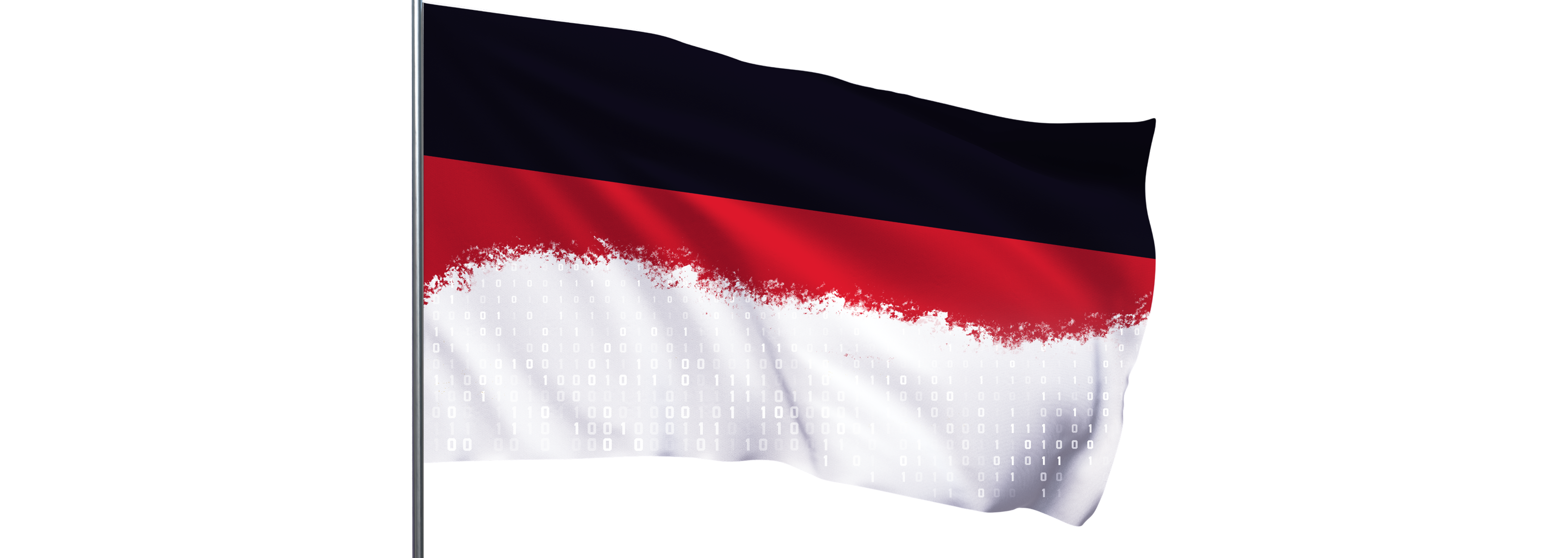
Roughly 47% of people in Germany think end-to-end encryption (E2EE) is a “very important” factor when choosing an app. An additional 31% say it is “somewhat important,” meaning roughly 8 out of 10 Germans (78%) value E2EE, one of the strongest forms of digital privacy protection. Germans also have a solid understanding of how the technology works, with 68% of people who know the term correctly identifying that only the sender and recipient can read E2EE messages.
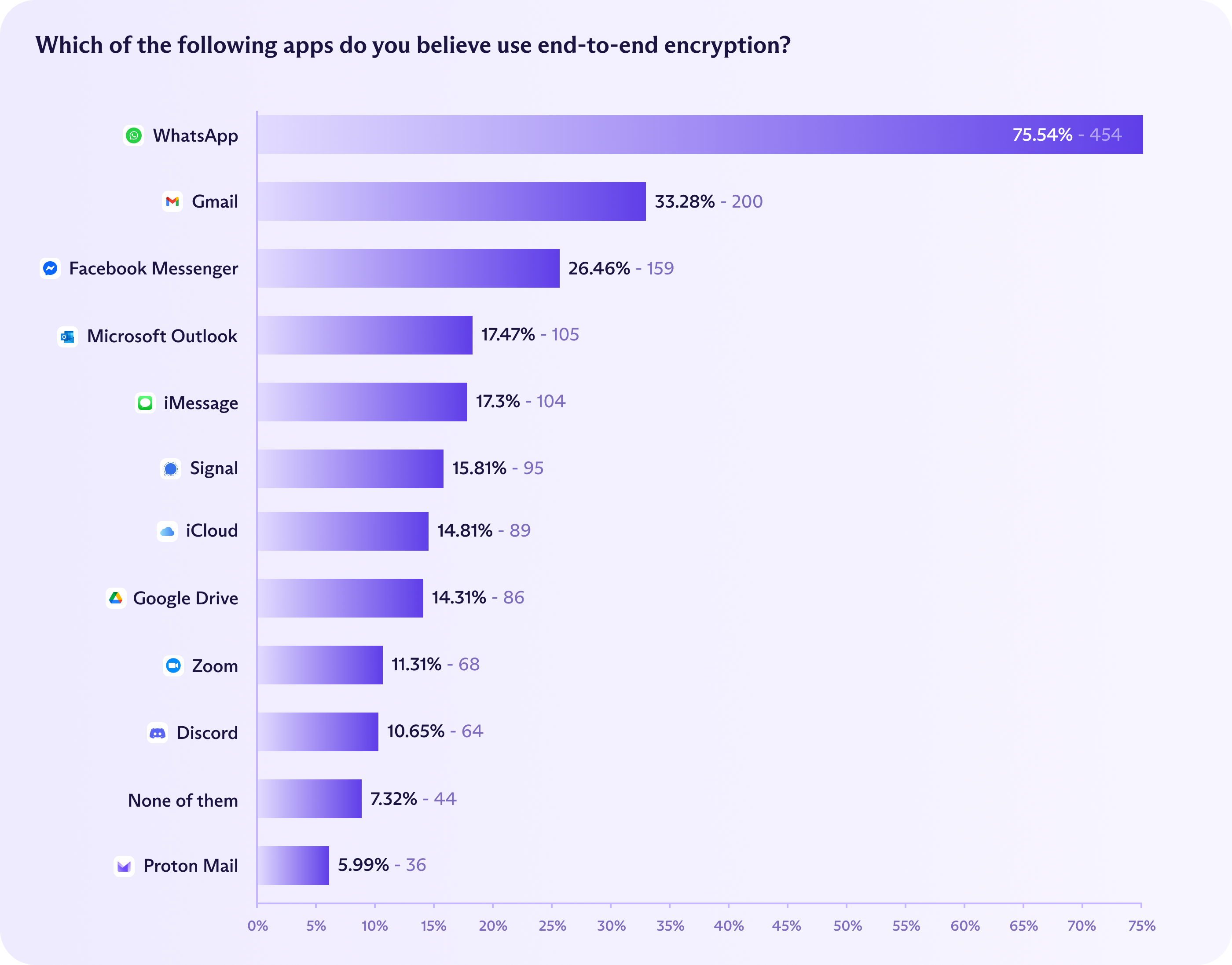
However, despite understanding what E2EE does, many Germans remain unclear about which services offer it. One in three respondents (33%) incorrectly believe Gmail offers E2EE, and 17% incorrectly believe Microsoft Outlook does (see graph below).
Yixin Zou, who leads the Human-Centered Security and Privacy group at the Max Planck Institute for Security and Privacy, thinks this confusion is deliberate. “Big Tech companies’ ongoing privacy washing contributes to the so-called ‘privacy paradox’ — where consumers value privacy yet make choices that compromise it,” Zou said.
78%
of German respondents called end-to-end encryption at least “somewhat important”
This gap between knowledge and application has real-world results. This survey, conducted in June 2025 among a general-population sample of about 600 adults in Germany and 700 in France, the UK, and the USA, found that most saw value in E2EE, the strongest form of protection for encrypted email, cloud storage, messaging, and other services that respect user privacy.
In fact, Germany placed the greatest value on E2EE of all the countries in our survey. The proportion of people rating it “very important” was highest in Germany (47%), followed by the US (43%), the UK (38%), and France (27%). Germany also had the highest combined proportion of people rating E2EE “very” or “somewhat important” (79%), ahead of the US (76%), the UK (73%), and France (61%).
Men are most likely to see E2EE as very important
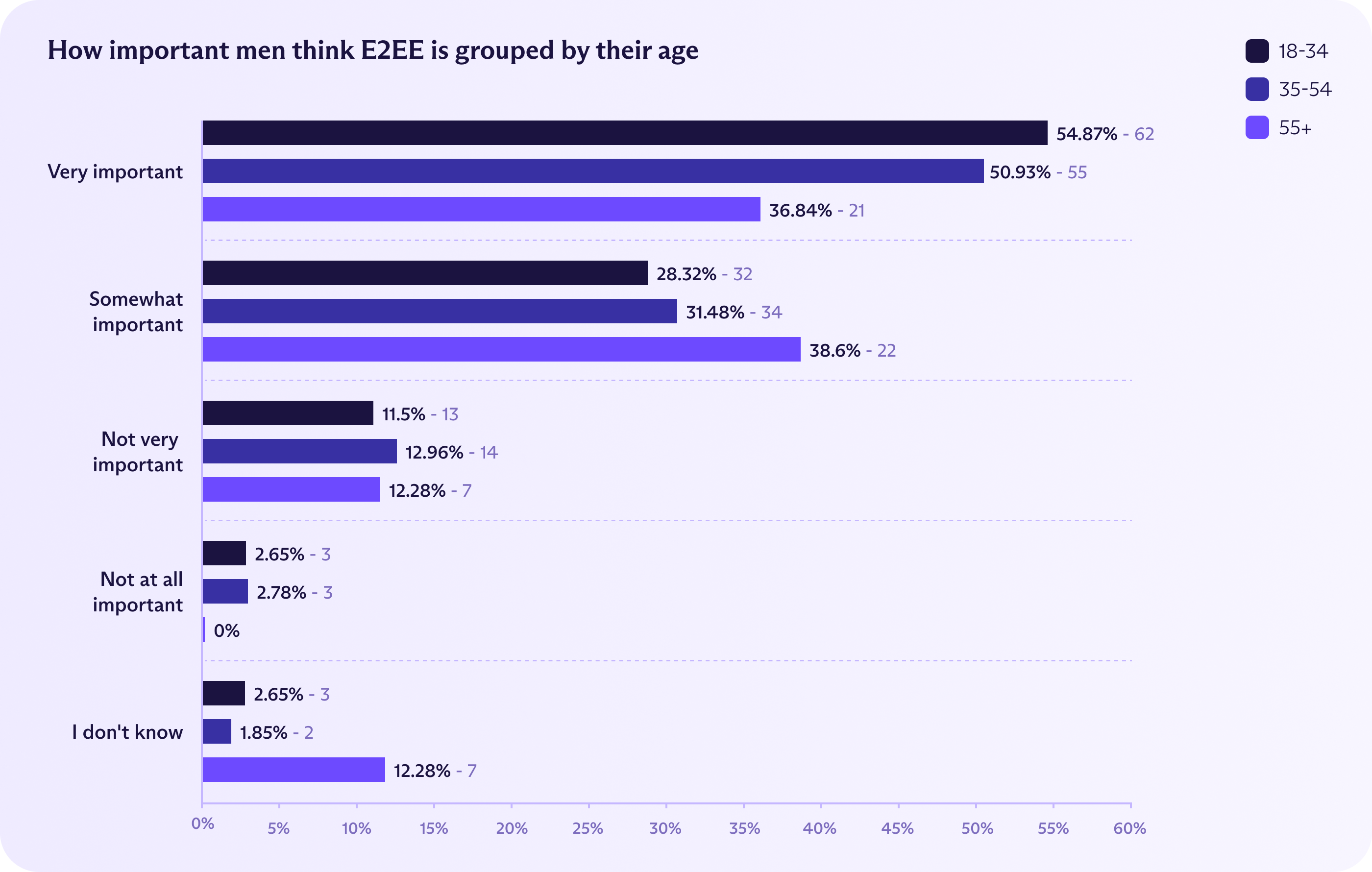
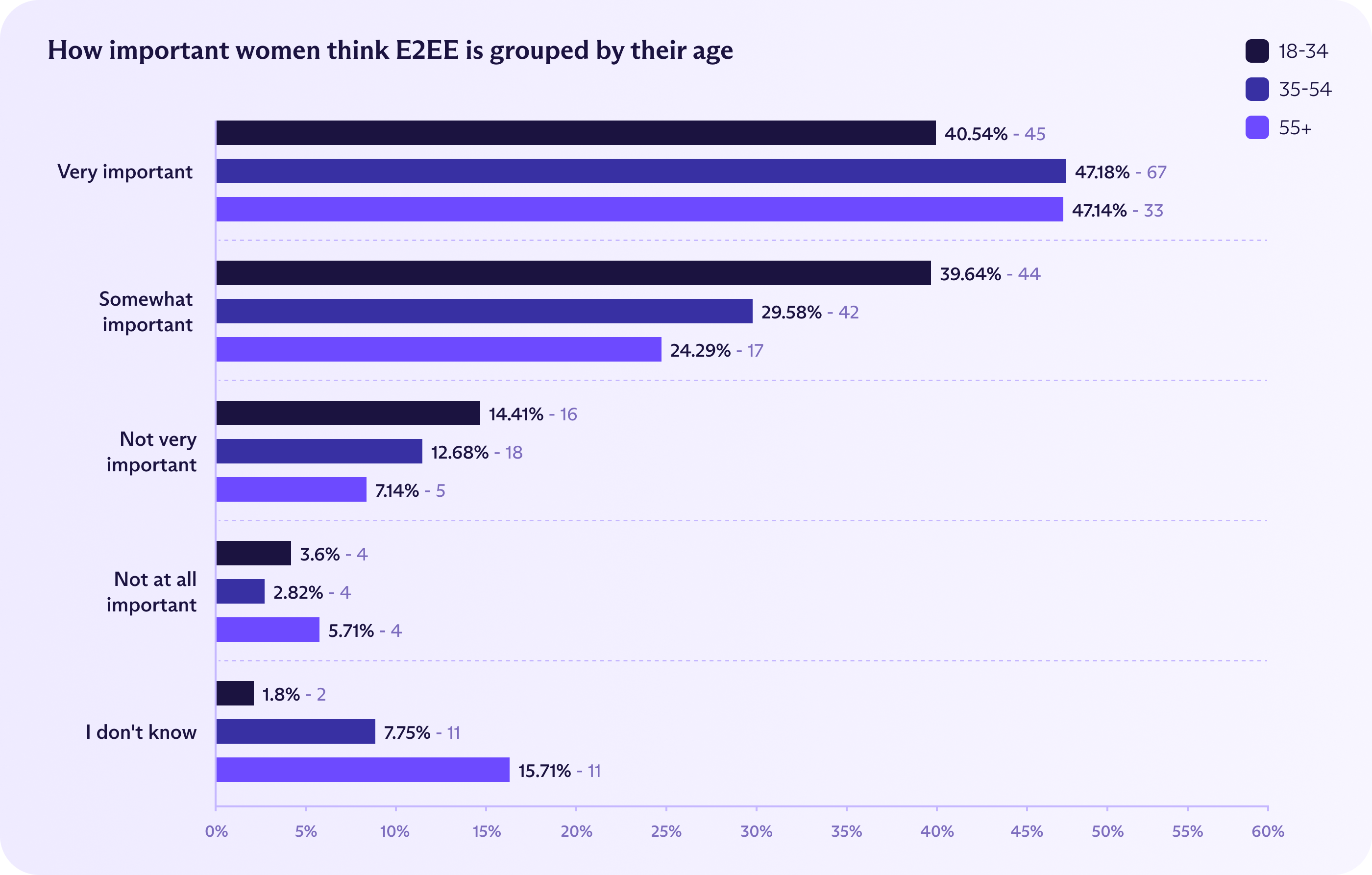
Young men are some of the biggest advocates for E2EE in Germany — we found this trend repeat itself in all the countries we surveyed. Roughly 55% of men under the age of 35 said E2EE was very important, and 51% of men between the ages of 35 and 54 said the same, the second highest group.
However, 47% of women between the ages of 35 and 54 and women over the age of 55 said E2EE was important, much higher than men over 55 (37%) or women under 34 (41%).
Misplaced trust benefits Google
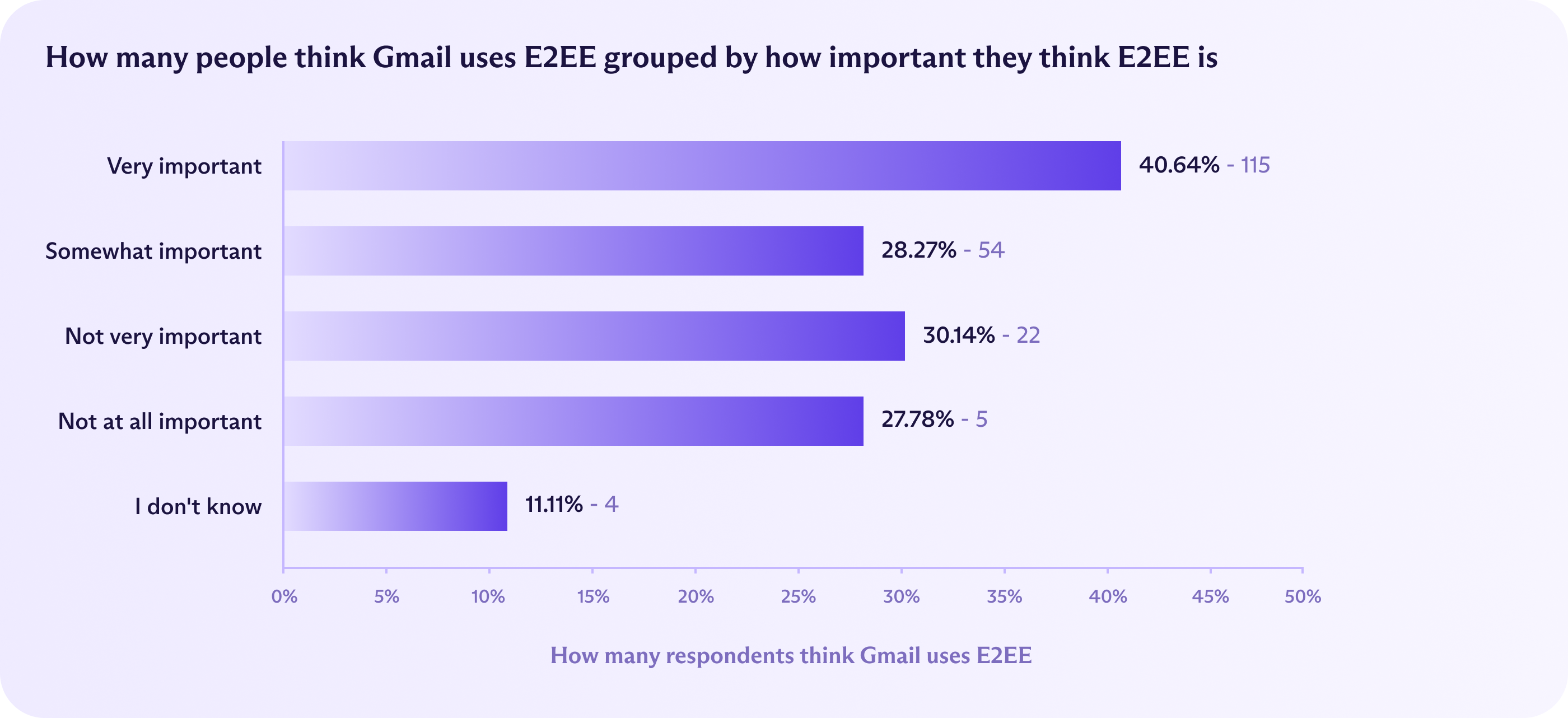
Google benefited greatly from the public’s misconceptions about security and privacy. People who consider E2EE very important were in fact more likely to say that Gmail used E2EE than the average person in our survey (45% compared with 33%). That same group was also more likely to see Gmail as private: 30% called Gmail “very private,” and 34% more said it was “somewhat private.”
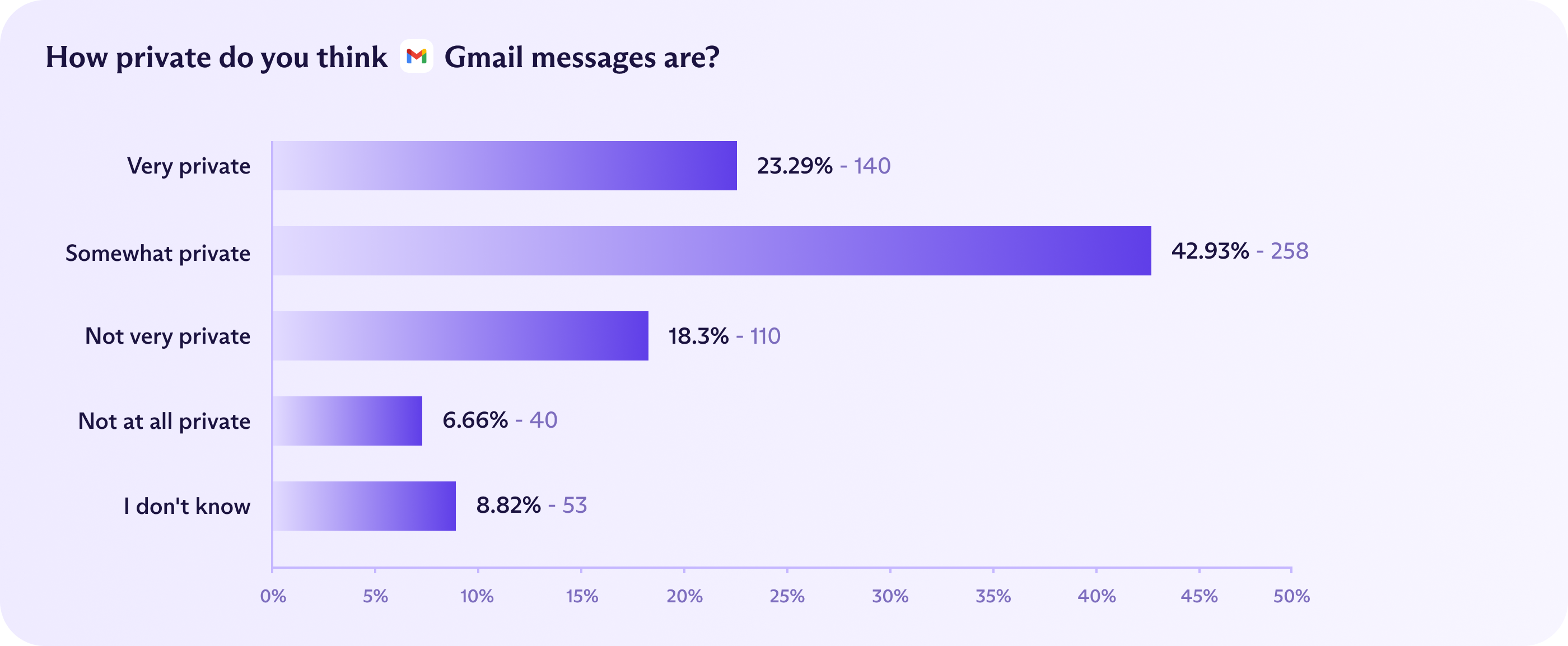
In fact, Germans were the most comfortable with Gmail’s privacy protections. Overall, 66% of Germans believe their Gmail messages were “very” or “somewhat private” — the highest trust level among surveyed countries, followed by the US at 61% and the UK at 57%. Ironically, the country that puts the least faith in E2EE, France, also has the least trust in Gmail, with only 48% of French respondents saying their messages were at least somewhat private.
Still, after learning that Gmail scans emails, 59% of Germans said they’d consider switching to an E2EE email service.
59%
of respondents said they’d consider leaving Gmail for a more private email provider
WhatsApp clear winner in awareness
Among all the apps we asked about, WhatsApp stands out. The service has long made E2EE a core part of its marketing, which might be why three in four Germans (75%) correctly know it offers the technology — the only E2EE service correctly identified by a majority of respondents. It’s also the most widely used, with 82% of respondents saying they’d used WhatsApp in the past 30 days.
Facebook Messenger was the second service correctly identified as offering E2EE with 26%. (Facebook made E2EE the default setting for Messenger in 2023.)
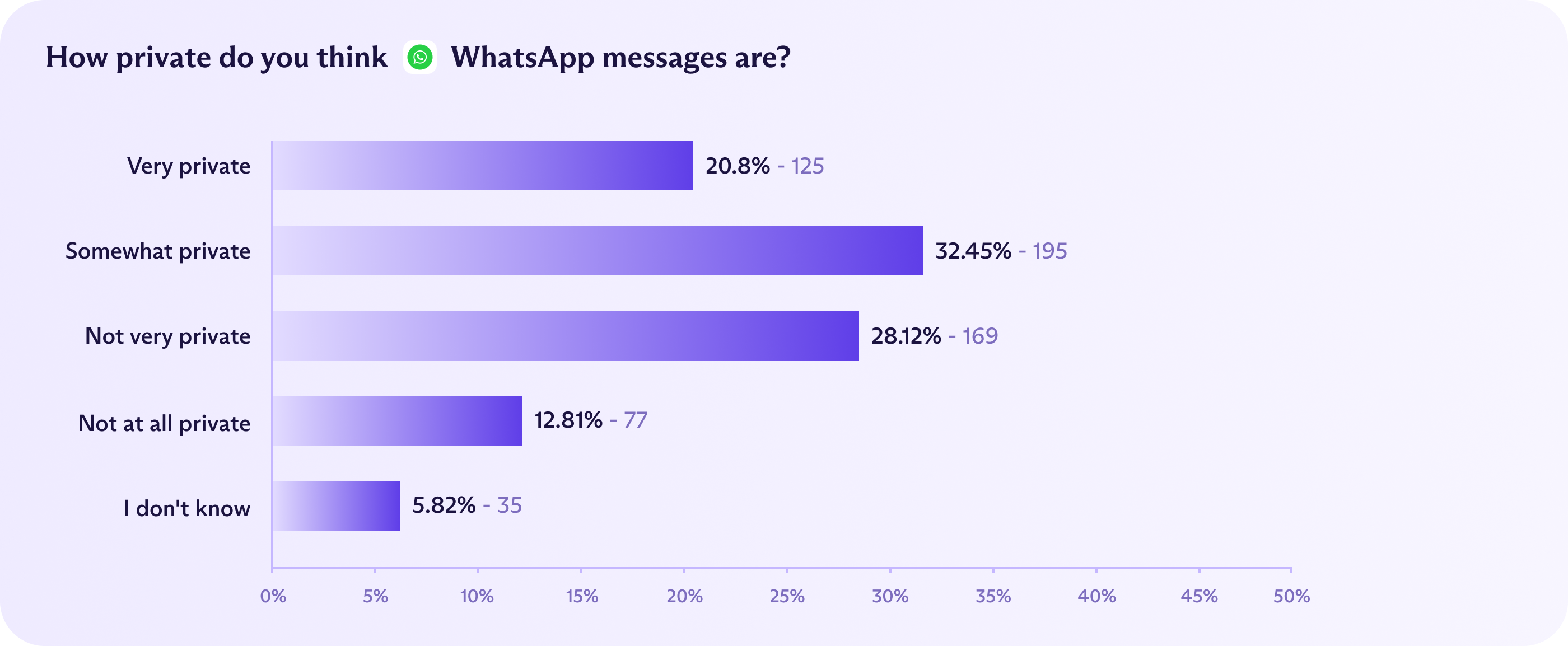
Awareness of WhatsApp limitations seems mixed. Nearly half of Germans (48%) said they already knew it collected metadata, like timestamps and contacts, and 46% said they already knew Meta, WhatsApp’s parent company, shared that metadata with governments around the world.
Despite these facts, 53% of Germans still said WhatsApp was “very private” or “somewhat private” and only 51% said they’d consider switching to a more private messaging service.
Why does E2EE matter?
Of course, communications sent via these popular services typically remain encrypted in transit, thanks to the widespread adoption of HTTPS. And while Google maintains that it stopped scanning through email to serve targeted advertising in 2017, it continues to do so to ward off spam and malicious content.
But whenever a service lacks end-to-end encryption, that means that there is no technical obstacle preventing the service from accessing its users’ email, files, and photos. Even if says it won’t, the service can always change its mind.
And services without E2EE also remain free to share the files they control with the government, if and when they are asked or ordered to do so. Indeed, Google and Meta, the parent company of Facebook, WhatsApp, and Instagram, are now receiving nearly 500,000 requests for information from US government sources each year.
Most Americans say they want encryption
Most Brits say encryption matters
3 in 5 people in France consider end-to-end encryption important