Encryption > Surveys > United States
Most Americans say they want encryption
But they’re still using services that don’t offer it.
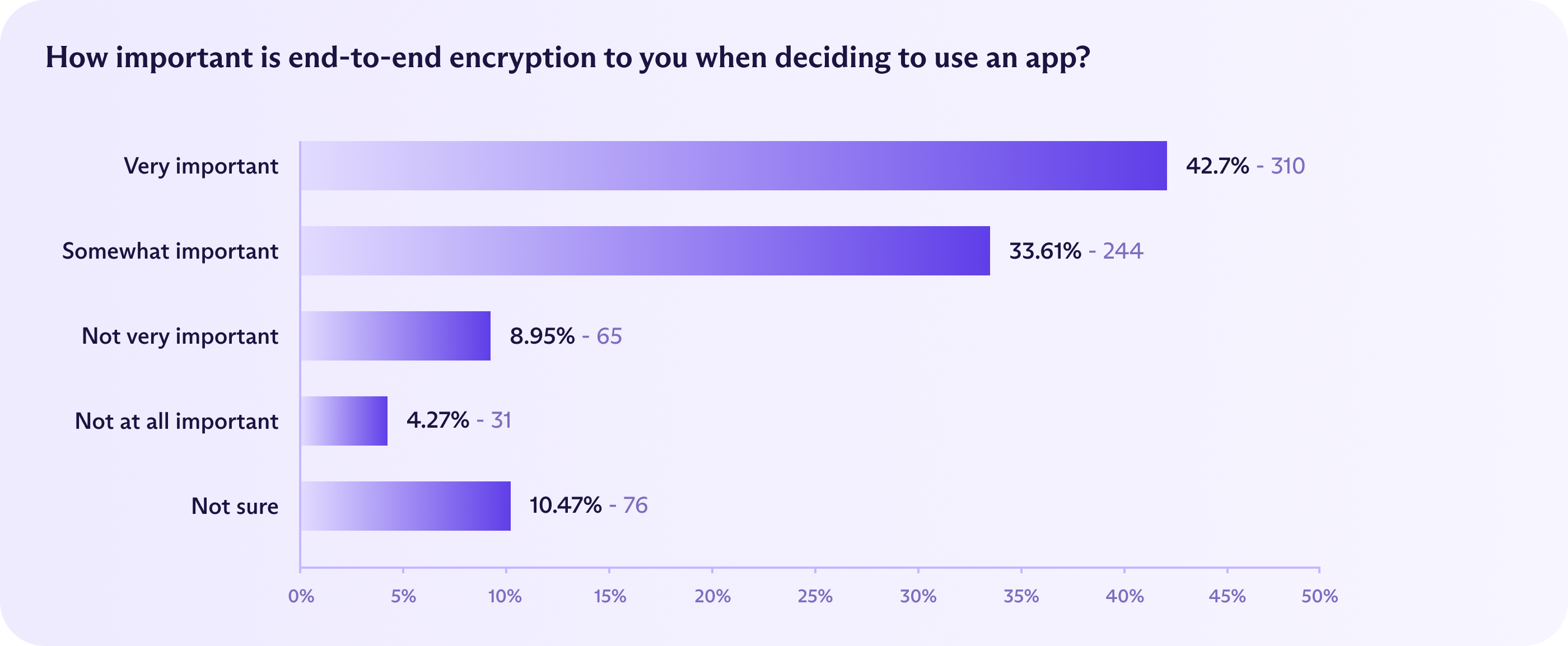
As governments and Big Tech argue over whether to weaken the privacy protections of end-to-end encryption, the American public seems to know what it wants: strong, private digital communication. According to a new Proton-commissioned survey, 76% of US respondents said end-to-end encryption was either “very important” or “somewhat important” when deciding which online services to use.
76%
of Americans called end-to-end encryption at least “somewhat important”
But that enthusiasm hides a bigger problem: Most people don’t fully understand what end-to-end encryption actually is. And that confusion could be putting their most personal and valuable data at risk.
The survey, conducted in June 2025 among about 700 adults in each of four countries — the United States, United Kingdom, France, and Germany — found strong, across-the-board support for end-to-end encryption. But the US stood out for the disconnect between that support and a widespread misunderstanding of which services actually offer the protection.
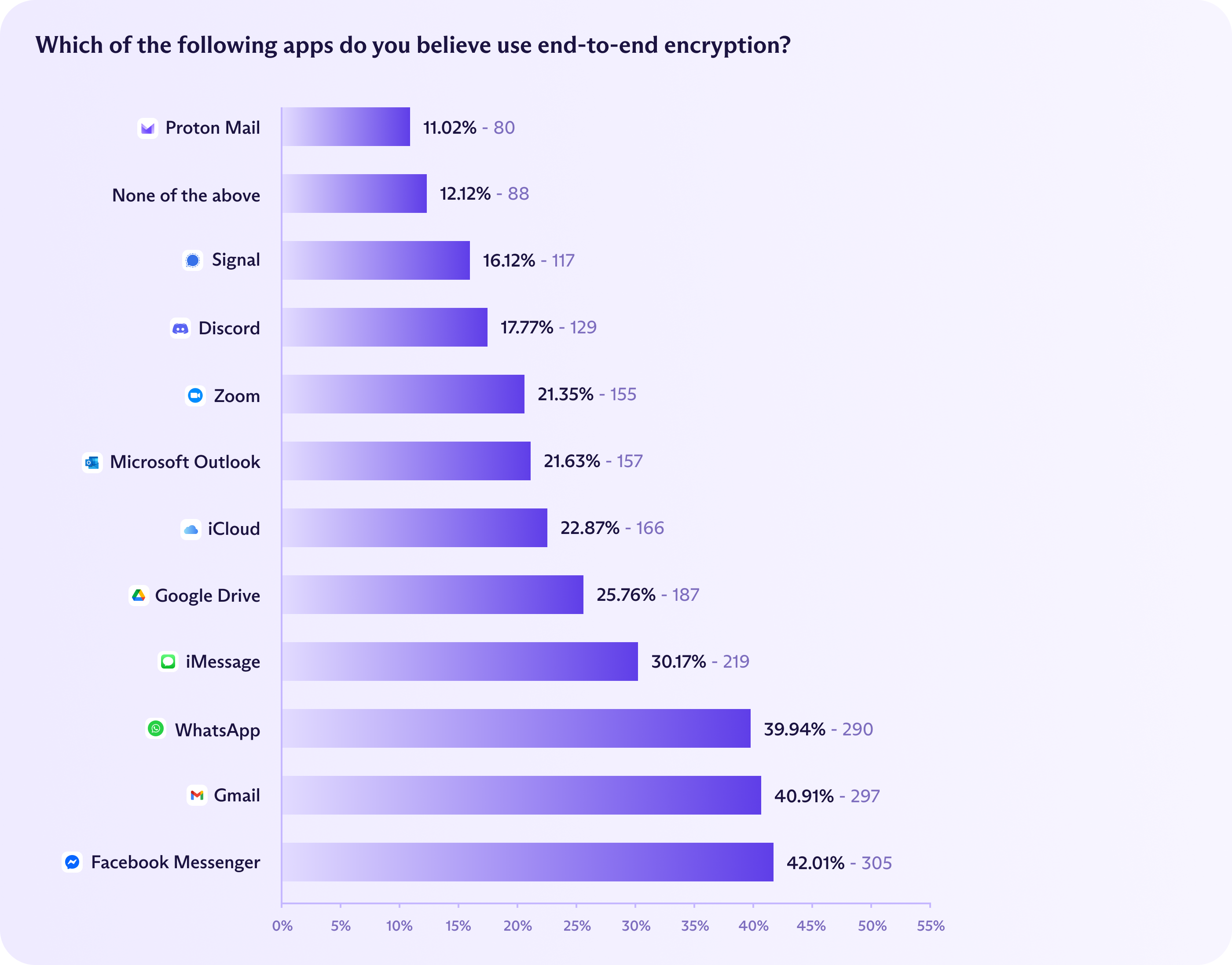
More than a third of Americans who said end-to-end encryption — also known as “E2EE” — was very important still answered incorrectly when asked who could access end-to-end encrypted messages. Some believed app providers and the government could still read them. Another 5% said they weren’t sure. Even more alarming, large numbers of people incorrectly identified services like Gmail and Discord as offering end-to-end encryption when they don’t.
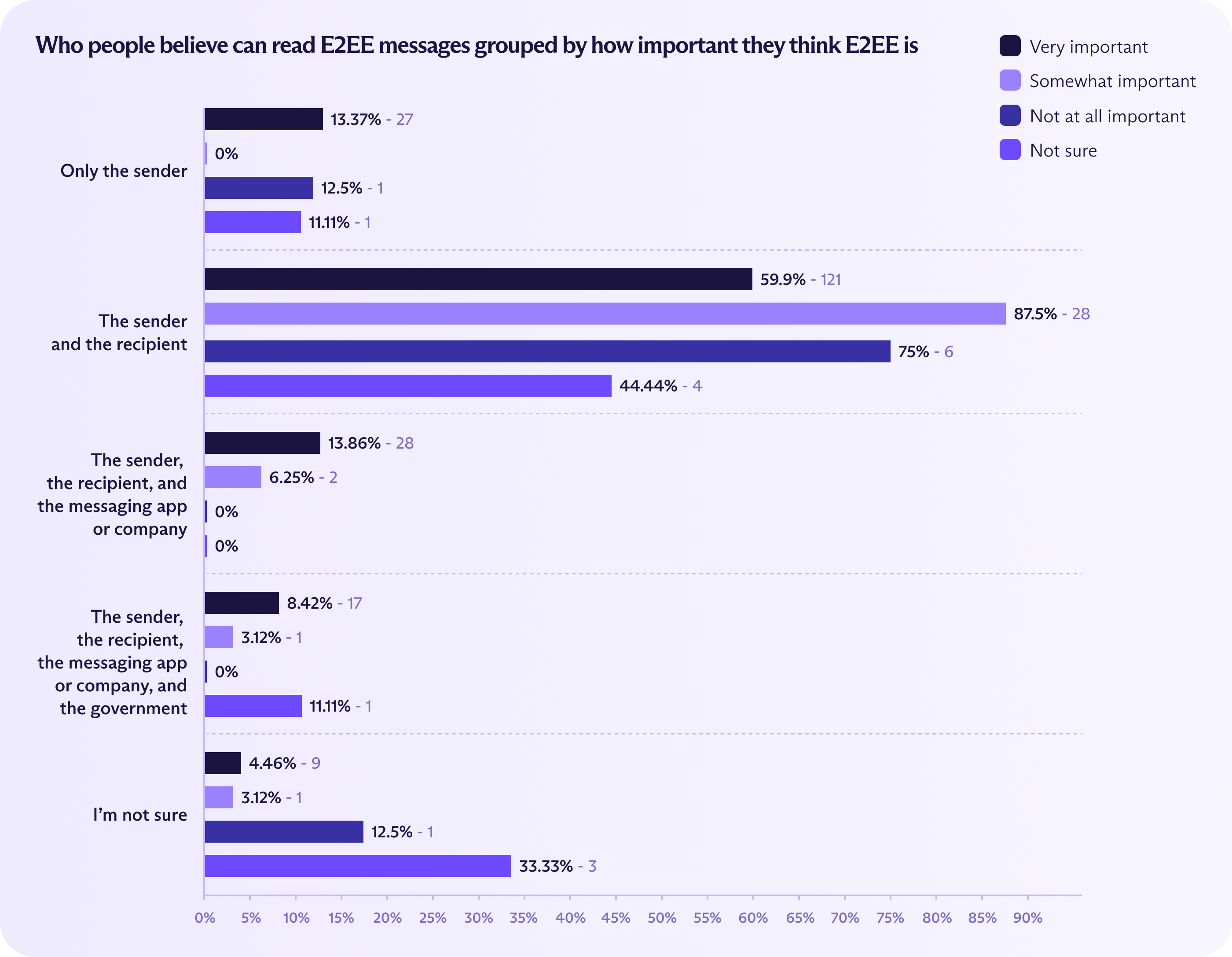
This disconnect suggests that while Americans are trying to make smart choices about privacy, they’re often relying on bad information, which is a key characteristic of the privacy washing campaigns Big Tech companies use to get the trust of users without actually protecting them.
41%
incorrectly believe that Gmail offers E2EE
Encryption confusion: Google’s halo effect
The survey results show that public trust in major US tech companies may be distorting how people evaluate privacy features. In the US, 41% of respondents said Gmail uses end-to-end encryption. In reality, it does not. Google can — and does — access Gmail messages for threat detection and other purposes. Google Drive also scored surprisingly high, with 25% of Americans believing it offers E2EE.
Despite these misperceptions, or maybe because of them, many respondents still believed Gmail was a private platform. Sixty-one percent of US respondents said Gmail was either “very private” or “somewhat private,” with 23% selecting “very private.”
This mismatch between perceived and actual privacy raises serious concerns — especially given that Gmail remains the most widely used email platform in the US.
Meta’s mixed reputation
The confusion didn’t stop at Google. Our survey also found that many Americans knew Facebook Messenger offered E2EE by default for personal chats even though it is a relatively new feature (added in 2023). It also ignores the fact that Meta collects a significant amount of metadata about your conversations.
42%
Forty-two percent of US respondents said Messenger was end-to-end encrypted. In contrast, just 40% recognized that WhatsApp, also owned by Meta, does promise E2EE by default, although a lawsuit filed after the survey was taken disputes that claim.
Perhaps most striking: Services that have been built from the ground up with encryption in mind, like Signal and Proton Mail, were identified correctly at far lower rates.
Name recognition, not technical reality, was the most powerful driver of public trust.

What does end-to-end encryption really mean?
True end-to-end encryption ensures that only the sender and recipient of a message can read its contents.
Even the service transmitting the message, whether it’s a cloud provider, email app, or messaging platform, cannot access the message content.
This is the gold standard for digital privacy, preventing snooping by governments, hackers, or the platforms themselves.
But if a service lacks E2EE, the app provider has the technical ability to read your emails, photos, and files — whether it claims to or not. And once that door is open, it’s easier for authorities or malicious actors to slip in.
Indeed, Google and Meta receive nearly half a million government information requests each year in the United States alone. Without E2EE, compliance is as simple as flipping a switch.
Is privacy a luxury reserved for the wealthy and educated?
The survey showed that Americans with higher income or education levels were more likely to say end-to-end encryption (E2EE) mattered when choosing which apps to use. Among wealthy respondents, 45% said E2EE was “very important” — and among college grads, the number was slightly higher at 47%.
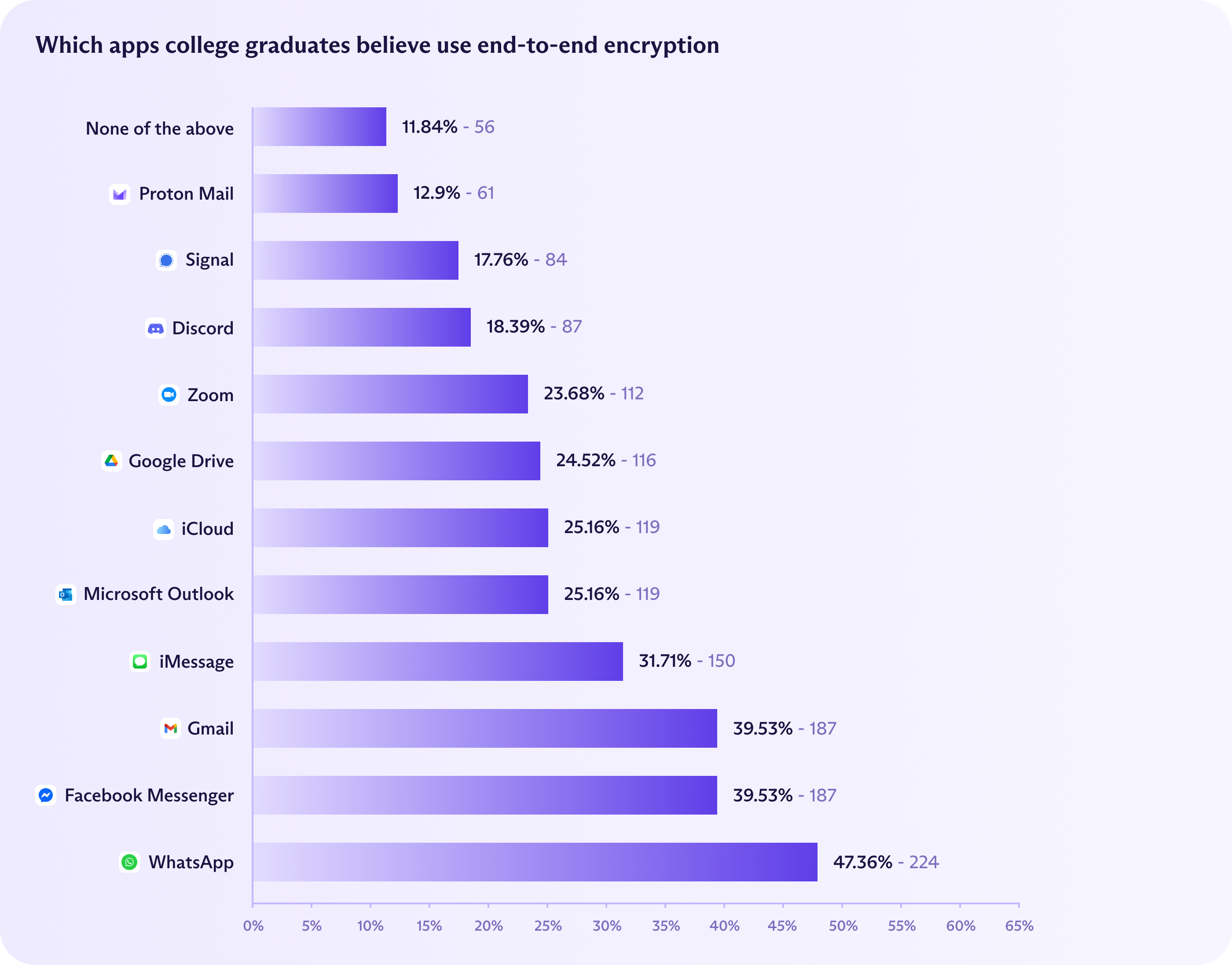
But when it came to correctly identifying which services offer E2EE, the numbers told a different story. Among college-educated respondents:
- 47% believed WhatsApp uses E2EE (correct)
- 40% said Gmail (incorrect)
- 40% said Facebook Messenger (correct)
- 18% identified Discord(new window)
- 18% said Signal (correct)
- 13% said Proton Mail (correct)
Among wealthy respondents:
- 44.9% said E2EE was very important
- 35.2% said it was somewhat important
These findings suggest a consistent gap between intent and actual understanding, which leaves the door open for Big Tech to continue pushing their privacy washing campaigns.
Big Tech and the illusion of privacy
When trusted brands like Google and Meta continue to market themselves as privacy-friendly while quietly collecting data or complying with surveillance demands, the result is what we call privacy washing: a misleading portrayal of digital safety that lulls users into a false sense of security.
At Proton, we’ve written about this many times on our blog. The takeaway from our latest survey is that the problem is worse than many think. People believe they’re protected when they’re not. And those most committed to privacy may not yet have the tools, or the information, to make fully informed decisions.
That’s why we’ll continue building privacy-first tools and tell the truth about what privacy means and who’s really offering it.
Nearly half of Germans think end-to-end encryption is very important
Most Brits say encryption matters
3 in 5 people in France consider end-to-end encryption important