Encryption > Surveys > United Kingdom
Most Brits say encryption matters
But they’re still using services that don’t offer it.
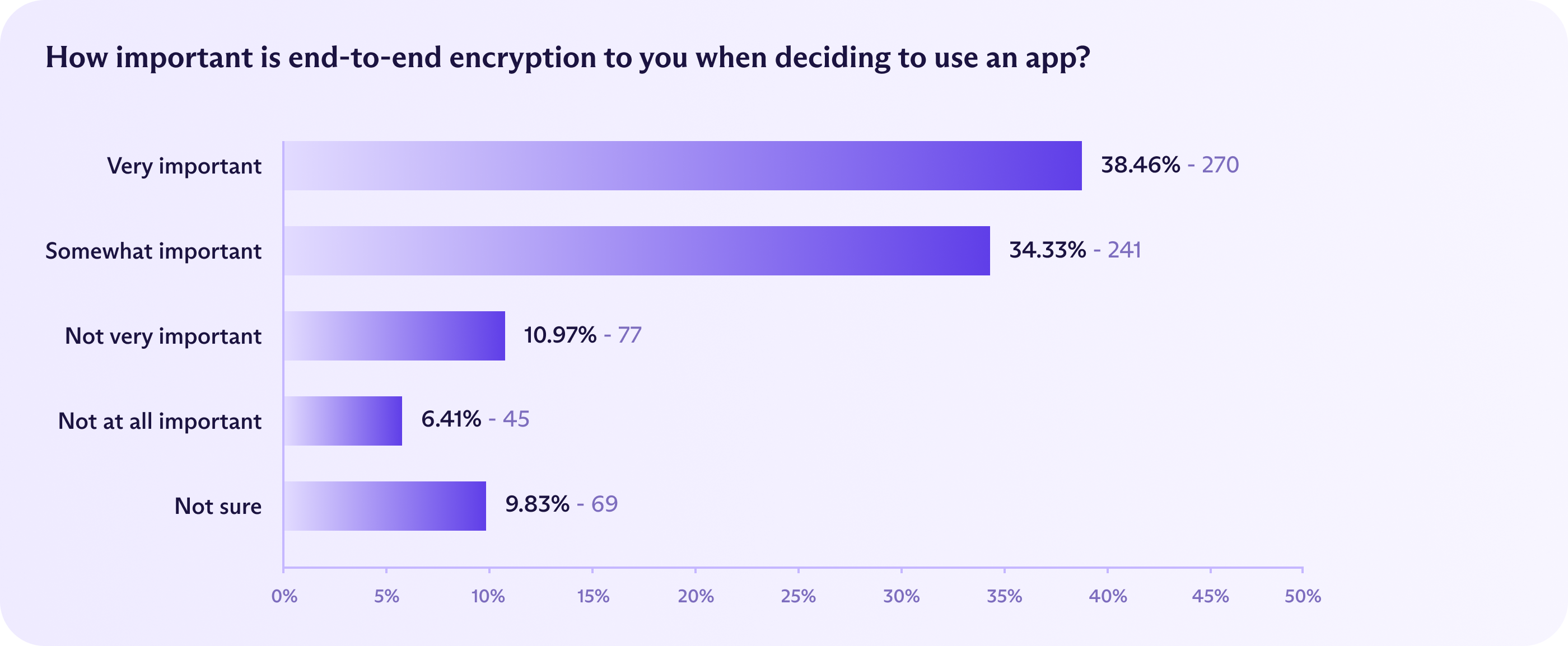
The story of end-to-end encryption (E2EE) in the UK is one of contradiction. British adults say they want it — 73% of those we surveyed told us that it’s important when choosing which apps and services to use. Many, however, are swiping, clicking, and uploading on platforms that don’t offer it.
73%
of British respondents called end-to-end encryption at least “somewhat important”
The Proton-commissioned survey, conducted in June 2025, polled 700 adults in the UK, alongside 700 each in the US, France, and Germany. It found broad public support for end-to-end encryption across all countries, but also a troubling lack of understanding about how it works and which platforms actually use it.
End-to-end encryption ensures that only the sender and recipient of a message or file can access its contents. That means not even the app itself — nor hackers, governments, or internet service providers — can look inside the black box that holds the data of your digital life. But when a service lacks E2EE, it retains the technical ability to access your most sensitive, valuable information, regardless of whether it promises not to.
Many people assume, our survey suggests, that their favorite platforms are more secure than they really are. This problem is made worse by the yearslong privacy-washing campaigns of Big Tech.
A misplaced trust in Big Tech
73%
Across the UK, 73% of respondents said end-to-end encryption was either “very important” or “somewhat important” in deciding which services to use. But when asked about specific services, many chose wrong.
14%
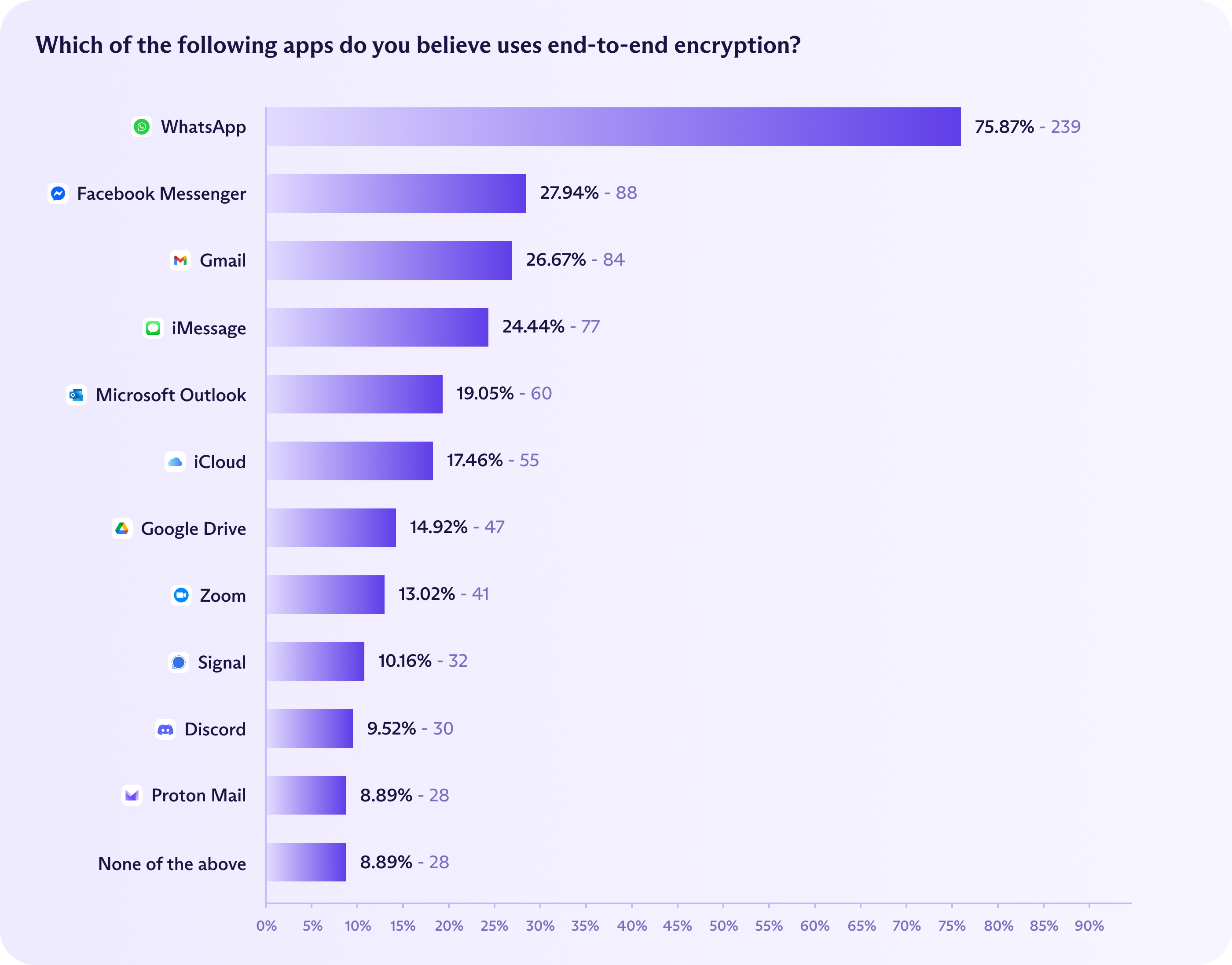
Roughly 26% of UK respondents, for example, believed that Gmail offered E2EE when it doesn’t. An additional 12% said the same about Google Drive. In reality, Google maintains technical access to both, even if it no longer uses the contents of your Gmail and Drive to serve ads.
57%
Despite that, 57% of Brits said they considered Gmail “very private” or “somewhat private.” That mismatch between trust and technical reality is a dangerous one, especially given the volume of sensitive communication that flows through popular Big Tech platforms like Gmail every day.
Meta’s services revealed a similar pattern. Just 28% of UK respondents correctly identified Facebook Messenger as end-to-end-encrypted (a setting the company turned on in 2023).
WhatsApp, which has long marketed itself as end-to-end encrypted, fared slightly better: 75% of Brits said it had E2EE — the highest correct response rate among the countries surveyed.
Even so, roughly a third of UK respondents said they didn’t know that WhatsApp collected metadata like timestamps and contact lists, or that Meta shared that data with government authorities when asked.
E2EE protects message content, but not the surrounding data — a fact many people still don’t fully understand.
27%
incorrectly believe that Gmail offers E2EE
Privacy washing is working
These misperceptions aren’t random. They’re the result of years of privacy-focused marketing from tech companies eager to project trust and safety without offering meaningful protections.
We call this privacy washing — the act of dressing up insecure systems as secure ones to attract privacy-conscious users. And it’s working.
Survey respondents were far more likely to trust and use familiar platforms than those purpose-built for privacy. Only 10% of Brits recognized that Signal, one of the most secure messaging apps available, offered E2EE. Proton Mail fared even worse, at just 9%.
The companies that talk loudest about privacy often aren’t the ones providing it.
A blind spot among high earners
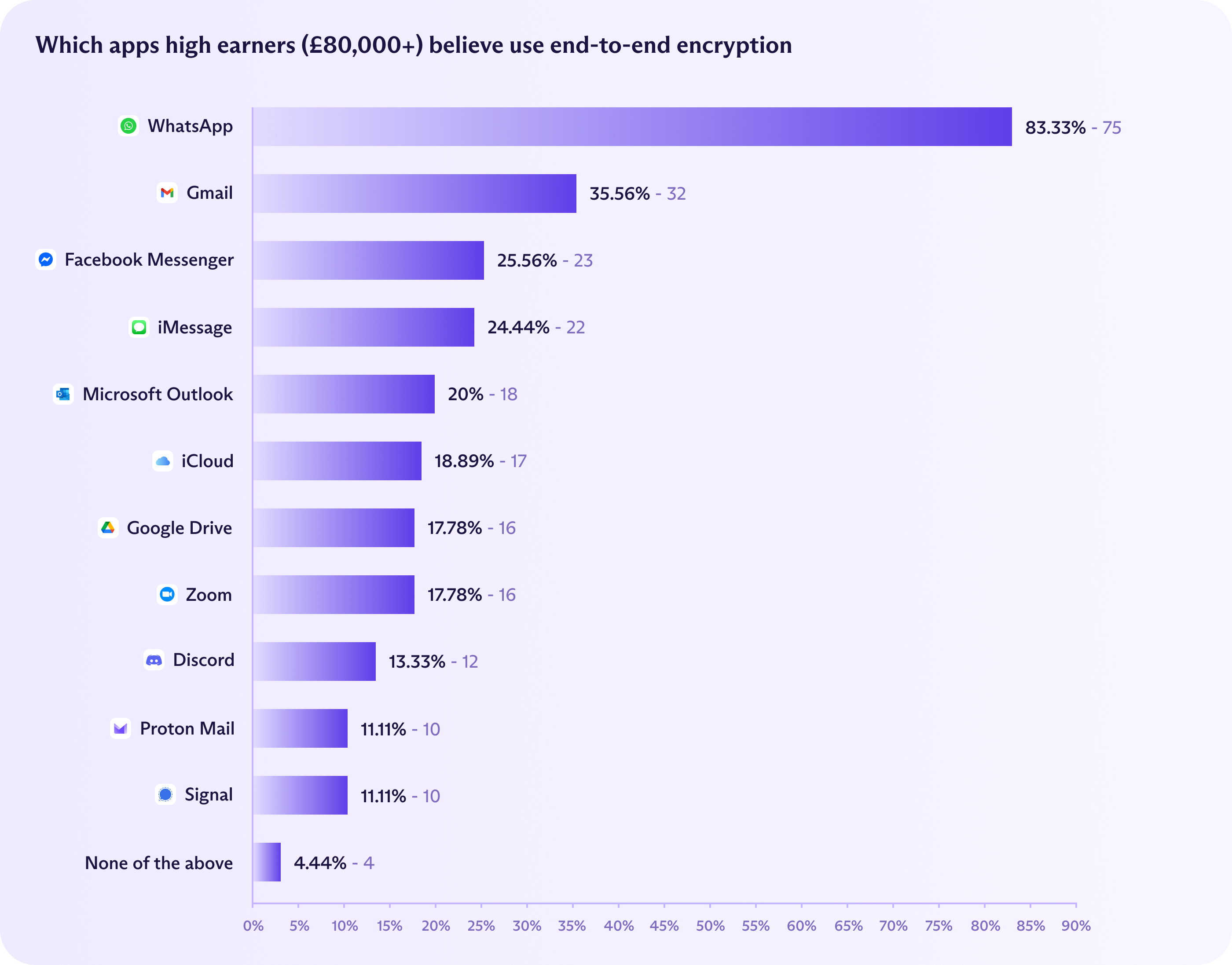
In the UK, people with higher incomes were more likely to say that E2EE mattered. Among respondents filtered by income, 49% said encryption was “very important” when choosing an app, with 41% more calling it “somewhat important.”
But even in these groups, actual knowledge lagged behind. Among respondents with an annual income of 80,000 GBP or greater:
- 83% believed WhatsApp used end-to-end encryption (correct)
- 36% (mistakenly) believed Gmail used end-to-end encryption, higher than the normal survey sample
- Only 11% correctly identified Signal
- Just 11% said Proton Mail used E2EE
This gap between perceived importance and real awareness helps explain how privacy washing thrives — and how even informed users can be misled.
A government that wants to break encryption
These findings come at a critical moment for privacy in the UK. In early 2025, Apple withdrew its Advanced Data Protection feature, which offered end-to-end encryption for some Apple services, after the government demanded backdoor access to iCloud data under the Investigatory Powers Act. The company has since challenged the order in court.
British lawmakers have long pushed for access to encrypted communications, arguing that it’s necessary to fight terrorism, child abuse, and other crimes. But cybersecurity experts warn that any backdoor — no matter how noble the intent — creates an exploit that hackers and repressive regimes could also use.
Without true E2EE, compliance becomes as simple as flipping a switch.
Privacy is a right — not a brand
The disconnect between the UK public’s desire for privacy and their use of insecure services reveals a larger truth: In the battle for digital rights, confusion is profitable. Big Tech benefits when people don’t know how encryption works — or assume they’re protected when they’re not.
At Proton, we believe privacy shouldn’t require a PhD or a six-figure salary. That’s why we’ve made end-to-end encryption the default across all our products. And it’s why we’ll continue to expose privacy washing for what it is — and empower people to make better choices.
You can’t demand what you don’t understand. It’s time to fix that.

Nearly half of Germans think end-to-end encryption is very important
Most Americans say they want encryption
3 in 5 people in France consider end-to-end encryption important